Tampilkan postingan dengan label Bellary district. Tampilkan semua postingan

Varavina Malleshwara temple

March 8, 2013
Varavina Malleshwara temple is about 4 kms east of Tekkalakote, the road passes through paddy fields. The moment we entered the place, it was like seeing a scaled down version of Hampi sans river. The scattered ruins, the architecture and the presence of a Frangipani tree was very much Vijayanagara style. It is said that the place was known as Devara Kallu ~ God's Stone when it was built. It was around 9AM, we were the only visitors. As you see the temple is situated on the hillock.

The hall on the left is the Kalyana Mantapa and the on the right is the main Gopura. Notice the pillar design, its quite different from the ones I've had seen earlier.

A pleasant surprise; a goshaala with half dozen calves. I love the look on their faces.

Gopura is brick and mortar.

The doorway is flanked by various sculptures. Just outside the doorway is a image could be a scene from Ramayana; Rama aiming an arrow at the golden deer while living in exile.

The presence of Damaru, Trisula and Nandi indicates lord Shiva here.

As we step in it felt as though we had entered from the back door. On our left was the care-taker's house. I wonder why those three tigers are painted... had Tipu donated money to this temple's maintenance.

On the left, after the tower is a long hall for pilgrims to camp. On the right is the temple.

Doorway to Sabha Mantapa. Well, I wish to meet the guys who painted..

Garbhagudi at the end of this aisle and to the right is Nandi (see inset).


A collection of hero-stones.
side entrance
This temple doesn't seem to have any kind of order, little confusing. Main Gopura is on the eastern wall but the Garbhagudi faces west and what seems like a south-facing side entrance must be the main entrance.


A mural resembling a human rib cage.. very strange piece of work indeed.
We could see half dozen small temples like these close to the base of the hills, on the plains. The larger structure on the right is a modern structure, a shed to park the temple chariot.


This shelter could serve as lodge for pilgrims or shops.
A short video by Malatesh.


I don't remember seeing any signage here, not much of information available. Having done with this holy place we head towards Udegola and Nittur to see Ashoka's rock edicts.

........

Nadivi fort

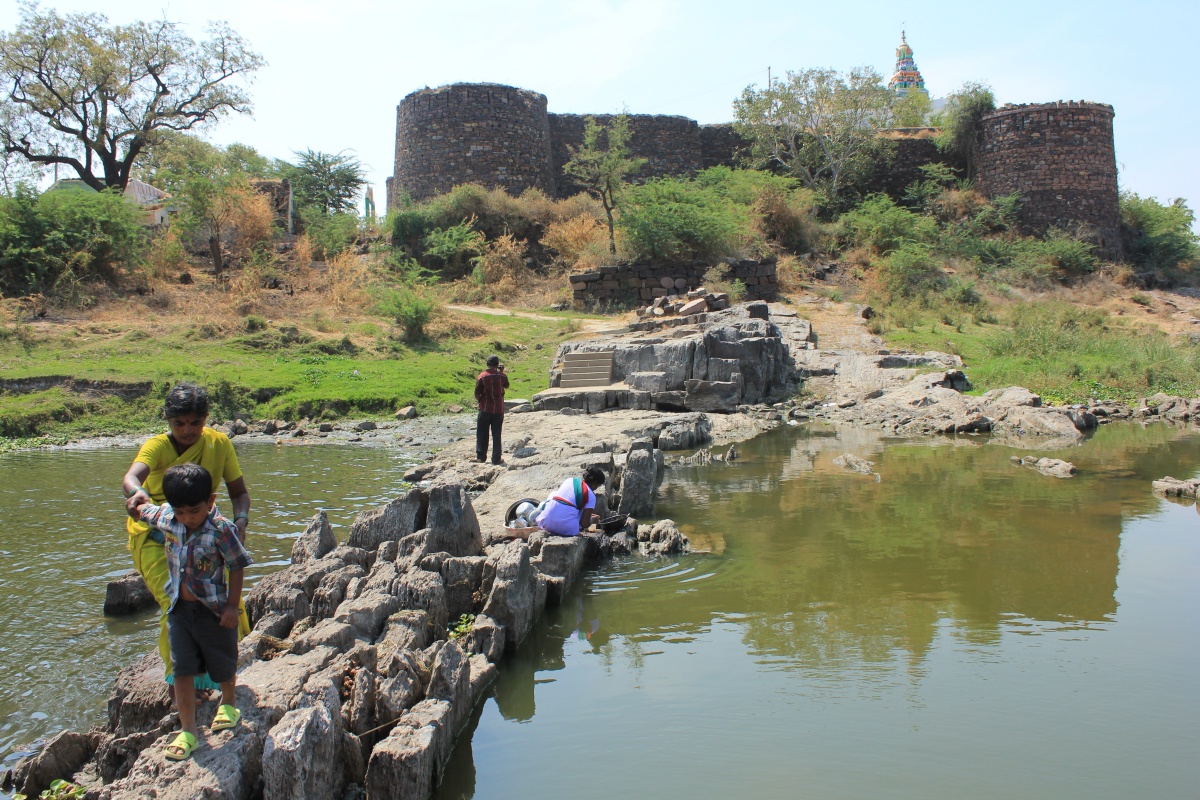
I stumbled on Nadivi fort while searching Wikimapia for Ashokan edicts of Nittur and Udegolam. This small fort is situated on river Tungabhadra right bank in Shirguppa taluq, Bellary district.
March 8, 2013
The road connecting Udegolam and Nadivi was pathetic but scenic. As we approached the fort, I decided to take the dirt road going left around the fort. We hit a dead end near the bastion and Ravi had to reverse his cab. Malatesh and I went by foot. I guess the fort was built some time between XV and XVII centuries.
This is the plan of Nadivi fort. Eastern and Southern walls do not exist anymore. About half the area within the fort is occupied by Ramlingeshwara temple.
I guess Nadivi fort was a sentry post for monitoring river traffic. Perhaps a sales tax check-post. Close to the base of this bastion is a shrine.
Southeastern bastion
The structure looks solid and well built. Stones seemed to be sourced from riverbed and nearby hills.

Northeastern bastion
Mortar has been used to bind the stones, that way the walls remain strong for long time. In my opinion, larger blocks make stronger walls - they withstand canon firing better than walls made of smaller stones. However downside of such forts is transporting and handling larger blocks.

That's Ramlingeshwara temple shikhara. We did not go in since the gate was closed and there was no sign of people inside. Its a east-face temple, probably a small structure earlier. To our right flows Tungabhadra.
Blue sky reflects in the slow-flowing waters of Tungabhadra. At this point the river flows in northeast direction. Such spots are considered holy in Hindu traditions and temples are built there.

Tungabhadra flowing towards the fort, as seen from Northwestern bastion.
There's a sudden change in the river bed- a very rough patch of stones creates a hurdle. When the water level is 3' higher they remain hidden. Boat navigators sailing here must have that knowledge else the boats will get wrecked. However, when the water level is much higher, most boats can pass over easily.

Tungabhadra flowing away, as seen from Northwestern bastion.
I wonder why the wall is bent here..

Wall with right angle bend
We went on the rocks, they are really rough and some very sharp too.

Here's a short video of this river fort by Malatesh.


On the way out, an elderly person called after us. He's a priest and performs rituals at Ramlingeshwara temple. He offered us flavored water and milk. The temple fair was due soon and invited us. Very friendly person. It seems that Nadivi Ramlingeshwara temple is popular for childless couples, special poojas are performed here which help overcome problems. We thank our elderly friend and say bye.


We head towards Nittur in search of Emperor Ashoka's edict.

Nadivi fort Coordinates: 15°30'25"N   76°48'17"E

.........

Fort Tekkalakota

March 8, 2012

Tekkalakote, also known as Tekkalakota, is a small town situated 45 km north of Bellary. Within the town limits is its fort- a small simple square shaped fort with circular bastions at each of the corner. The fort's main entrance faces north direction. It also has a small doorway on the western side.

The fort is a education hub of the town, a school and a college are within the fort premises. We are standing in front of Mahadwara ~ main entrance. The colorful building on the right is a junior college. Behind me is another ancient stone wall which was built as security of Mahadwara. And on my left, out of sight, is another row of class rooms.

Mahadwara - main entrance.
I couldn't find any info about the fort on the net nor people at the town could provide any info. Hence I'll have to do a some guessing. The construction is pretty advanced, binding material is used in the walls. So this fort cannot be very old. Since this fort is located close to Hampi, it must be built during Vijayanagar times. The symmetrical floral hangs in the doorway is a typical feature in Vijayanagara architecture. 

Twin halls on raised platforms flank the gateway. Those would be security offices of the fort.

Within the walls are two small buildings, close to the south-eastern bastion. I wanted to take pictures from the building's roof, of course with permission. We spoke to a lady in-charge and learnt this is a residential school for girls, students are from nearby villages, mostly from poor families. Its a different type of school, it provides vocational training to its students besides regular academics. The schools objective is to train these youngsters to be better prepared for the outside world. Initially the lady was hesitating to let us go to the terrace, when we told her about the purpose she allowed us. It was actually convenient for Malatesh to shoot with his camcorder from the terrace.

Nearly half the area is taken by Neem tress :-) fresh cool air for students. However, view of the gateway is also obscured by the trees. In the background are the hills of Tekkalkote.

The south-eastern bastion. All bastions seem to be well preserved but the surroundings aren't so clean. I suspect the fort had a moat once..

Glimpse of the north-eastern bastion.

A peep at the side entrance. I did not want to take chances of exploring what lay beyond this gateway.

The teacher suggested us to visit Varavina Malleshwara temple near by. She told us the temple is ancient and we would surely like the place. We thanked her for the suggestion and said bye.

It was quick tour. We planned to got check out Varavina Malleshwara temple, about 4 kms east of Tekkalalote.

Recently I learnt that hills of Tekkalakote is a Neolithic site where archaeologists have discovered the foundations of circular huts and a small cemetery. While driving from Tekkalakote to Udegola we had to pass by the hills, the very look of the rock formations evoked thoughts of inhabitants on these hills. In fact I pointed out couple of rock shelters to Malatesh and told him we must check them out someday. Well, I really want to explore those hills someday.. we might see some rock paintings and prehistoric paintings are always interesting.

Tekkalakota fort co-ordinates: 15°32'4"N   76°52'50"E

.........

Ashokan minor rock edict of Nittur

The discovery of Asokan Minor Rock Edicts I and II at Nittur were reported in the newspapers late in the year 1977. The Nittur inscription raises the number of MRE I copies discovered in Karnataka from six to seven and that of MRE II versions from three to four. The existence of the two boulders with some writings on them was reported by E Visvanatha, a junior engineer of the Office of the Senior Geologist at Bellary to the Department of History and Archaelogy, Karnatak University, Dharwad. The inscription is situated 1½ kms south of village Nittur, Shirguppa Taluq in Bellary district.

March 8, 2013
Tekkalakote fort, Varavi Malleshwara temple, Asoka's edict at Udegolam, Nadivi fort.. those are the places we visited before coming to Asoka's edict of Nittur. Weather was warm but the carpet of paddy fields gave a cooling effect to the eyes. The edicts are situated at the base of a rocky hillock. The two granite structures in the center of the picture are recent creations to protect the boulders from sun and rain.
We could drive to the base of the hillock, we parked our cab near boulders. The care-taker was there alone. He was expecting us; his friends at Udegolam site had called informed about our visit. He said he was expecting us earlier, I told him about our little visit to Nadivi fort before coming here. I walked into one of the fields to get a view of boulders and part of the hillock.

Like Udegolam site, Nittur site also has two minor rock edicts. I'm assuming that boulder on the left has MRE I and on the right is MRE II.

Here we are looking at the 10' high boulder, on the surface facing is the inscription.

That's Mr.Prakash, the care-taker. We appreciated his sense of duty, the monument is kept clean and tidy. However, we were surprised at the absence of signage for such an important inscription.

The inscription is in Brahmi script and language is Sanskrit. This is MRE I- has 7 lines covering an area measuring 4' high x 18½' long. Letters' are 3½" to 8" high.

Now I turn to 'Ashokan Studies" a book by D C Sircar, to learn more about the inscription. Thanks to Mr. S B Hiremath, Director In-charge, Kannada Research Institute, Karnatak University, Dharwad for lending me this book. Incidentally, back in 1977 Mr. S B Hiremath was a member of the team from KUD who was here to document the newly discovered edict, he was a student at that time. He remembers spending four days at the site; a makeshift shelter was erected to protect them from wind and rain. Coming back to the book, it has information about recently discovered edicts of Emperor Asoka. Besides information about the discovery, transliteration and translation of the inscription, it also has photos of the impression sheets. Here are the scanned copies.

Picture source: Asokan Studies by D C Sircar

TRANSLITERATION of MRE I
1. (I) Deva[nam]piyo he[vam] aha (/*) (II) adhvi(dhi)kani adhatiyani [va]sani yam..
2. [u]pasake [no cu] kho b[a]dham pakamte husam ekam [sa]mvacharam (/*) (III) satireke tu kho samvachare yam maya sanghe u
3. puyi[te].. ca me pakam[t]e (/*) (IV) imi[n]a kalena amisa....munisa Jambudipasi mi[sa] [deve]-
4. [hi] (/*) (V) pakamasa hi [iya]m pha[le] (/*) (VI) [no] hi iyam [mahapten=eva] sake papotave (/*) (VII) kama[m]         [khuda]ken=api paka9ma0mi[ne]ua vi[pule] [svage]
5. sake aradhayitave (/*) (VIII) [sa] [e]taya iyam a[tha]ya [savane] savapite yatha [khu]daka ca ma[ha]pa ca imam pakameyvu am[t]a pi ca me [jane]y[vu] ti (/*)
6. (IX) cira-thitike [ca] i[ya]m pake(ka)mehoti (/*) (X) imam ca v[ip]u[le] vadh[isiti] [badha]m ca vadhisti avaradhiya diyadh[i]yam [vadhis]iti (/*) (XI) iyam ca savapite[ne]
7. [sa]vapite v[yu]thena [200 50 6] (/*) (XII) [sava-pa]thaviyam ca viva[s]ite ti (/*) (XIII) yatha ra[j]a Asoka aha tatha(tha) ti (//*)

TRANSLATION of MRE I
(I) Thus saith the Beloved of the Gods.
(II) It is more than two years and a half that I have become an upasaka (i.e. a lay follower of the Buddha), but was not excessively zealous [in the cause of Dharma] for one year.
(III) However, it is more than a year that I have been intimately associted with the Sangha (i.e. the Buddhist Church) and have been exerting myself [in the cause of Dharma].
(IV) By this time, in Jambu-dvipa (i.e. Asoka's empire), people who were unmingled (with gods) have been mingled with the gods.
(V) This is the result of [my] exertion [in the cause of Dharma].
(VI) Indeed, it is not only the big (i.e. rich) men who are capable of achieving this.
(VII) Even the small (i.e. poor) man, who exerts himself [in the cause of Dharma].
(VIII) Thus this declaration has been issued for the purpose that small and big men i.e. the rich and the poor exert [in respect of] this [matter] and the people living on the borders [of Asoka's empire] may know [about it].
(IX) And [in this way] this exertion [in the cause of Dharma] becomes everlasting.
(X) This exertion will increase to a considerable extent, will increase greatly [and] will increase more or less to one and half times.
(XI) This declaration has been issued [by the king] when he was away [from his capital on a tour of pilgrimage after the elapsing of] 256 [nights i.e. days of the tour].
(XII) {This edict] has been dispatched throughout the entire earth (i.e. Asoka's empire).
(XIII) [this has been done] in the way as it was said (i.e. ordered) by king Asoka.

As seen from the side, from the space between the two boulders.

Now we turn our attention to MRE II.

As seen from the paddy field.
As seen from the space between the two boulders.
This is the boulder which carries Asoka's message of peace... the same message Buddha had given the world.

Closer look at the text. This is MRE II; it is in 5 lines covering an area measuring 3' x 19'. Letters are smaller compared to MRE I.

Scanned copies photos of the impression sheets.

Picture source: Asokan Studies by D C Sircar
TRANSLITERATION of MRE II
1. (I) [r]aja Asoko hevam aha (/*) (II) tuphe anapayatha Rajuke (/*) (III) [se] [a]napayisati j[a]napadam ca janam Rathikani ca (/*) (IV) mata-pitusu sususita [v]iya ti (/*) (V) [h]evama garusu (/*).
2. (VI) panesu ca dayitaviye[e] ti (/*) (VII) ime dharma-guna pavatitaviya [t]i (/*) (VIII) .. [tu]phe Rajuka anapayatha (/*) (IX) se dan[i] Devanampiyasa vaca[ne][na] [a]na[pay]i[sa]t[i] (/*) (X) se hemava ana[pa[yatha (/*) (XI) he[meva] [ca]
3. Bamhanani ca hath-arohani ca karanakini ca yug-a[cariyani] ca (/*) (XII)..........[yadisi] [po]rana pakit[i]..(/*) (XIII)..[ana][pa]y[i]sati (/*) (XIV) ..sususitaviya ti (/*) (XV) iyam apacayitaviye ti (/*) (XVI) acaliye apacayi-
4. taviya ca sususitaviya ca (/*) (XVII) ye acali ..............................ti (/*) (XVIII) [i]yam [ya]tharaham [pa]vatita[v]iy[e] ti y[a]d[i]si porana paki[t]i (/*) (XIX) yatha.
5. hi satireke huveya tatha pavititav[i]ye [ti] (//*)

TRANSLATION of MRE II
(I) Thus saith king Asoka
(II) You (ie.e the Kumara and his Mahamantras) [should] pass orders on the Rajjuka
(III) He will pass oredres on the people of the countryside as well as on the Rastrikas.
(IV) "[One] should be obidient to [one's] parents."
(V) "In the same way, [one should be obidient] to one's elders."
(VI) "[One] should be kind to the living beings."
(VII) "One should propound these attributes of Dharma."
(VIII) [Thus] you should pass orders on the Rajjuka.
(IX) He will then pass orders [on his subordinates] in the words of the Beloved of the Gods.
(X)  Therefore you should pass orders [on the Rajjuka].
(XI) And in the same way, [orders should be passed on] the Brahmanas (i.e. the teachers of the Brahmana community) elephant riders, scribes and charioteers.
(XII) '[You should instruct your pupils] in accordance with what is the ancient usage'
(XIII) [He, i.e. the Rajjuka] will pass orders [as follows].
(XIV) "[The instruction] should be obeyed [in the same way.]"
(XV) "This should be held in respect."
(XVI) "The teacher should be honoured and obeyed."
(XVII) "Again, those who are the teacher's [kinsmen, among them also the instructions should be established.]"
(XVIII) "This should be established in the proper manner in accordance with what is the ancient usage."
(XIX) "{This] should be established in such a way that it becomes abundant."

Video link to Asokan edict of Nittur.

Here's a map of Nittur-Udegolam area. Roads connecting Tekkalakote and Udegolam/Nittur are dirt tracks but surface is good.


Tekkalakote to Udegolam site = 6½ kms
Udegolam site to Nittur site = 3½ kms
Tekkalakote to Nittur site = 10 kms

Today we are keeping up with the itinerary, the progress is good so far. Next on our list is Halaekote, a fort between Tekkalakote and Shirguppa.

Site Coordinates: 15°32'49"N   76°49'57"E
.........

Ashokan minor rock edict of Udegola

I had spent hours researching Google maps trying to find the exact location of Nittur and Udegolam; found Nittur village but Udegolam was unmarked. Also I wasn't sure if these edicts were within the villages or situated in a remote place like Palki Gundu. Well, I did not want to assume anything.. let me go there.

March 8, 2013
We had left Bellary early; our first stop was Tekkalakote, next was Varavina Malleshwara temple 4 kms east of Tekkalakote. We came back to Tekkalakote, got directions for Nittur. The road was flanked all boulder strewn hills; the very look of those  hills gave a feel of prehistoric human settlements; in fact we could see a couple of rock-shelters on the slopes, perfectly suitable for humans to live in. I eas tempted to stop and explore but the thought of upsetting the itinerary was not a good idea. After couple  of kilometers the tar road gave way to a narrow mud road. At a brick factory the path turned right and left; we entered the paddy belt. It was a carpet of green as far as we could see; we could see rock-formations too. Instead of heading to Nittur straight away we stopped at the first person we met to ask for directions. This person guessed our purpose, he suggested us to see Udegola first, which we were closer to and gave rough directions to Nittur site. Thanks to than man; I was relieved now :-)

A narrow path led to a rock formation; we could see a short flight of steps leading to a small rock shelter protected by brick-wall, grills and doors. I went in and peeped, it was a temple. I scanned the surroundings; behind a clump of Neem trees was a granite structure- close to the left edge in this picture.

There it is- Asoka's minor rock edict of Udegolam.
Two women and a little boy were sitting close by, they told us the care-taker was on sick leave :-(
I offered to take pictures of them but they were too shy, even the kid did not want his picture taken.
Minor Rock Edict II
The edict was inscribed on the entire surface facing us. However, some parts of the inscription was barely visible. I guess trained epigraphists' eyes can catch text better than any layman's eyes.

A closer look- click on the image to enlarge it - that way you'll see the letters.

I guess exposure to nature's forces the surface chips of in layers. I hope this shelter helps preserve it better.

Other side of the boulder. The place is silent and peaceful. I wish I had more time to explore & inspect the rocks behind me. The ladies told us about the second inscription close by ..a minute's walk in the direction we are looking.

Few minutes later a man came, he seemed to be the father of the kid. He accompanies us to the second inscription. Here it is-

Minor Rock Edict I
We were looking at a plain surface, no text. Then a careful, closer look at the rock we could identify faded text.


My heartfelt thanks to Mr. S B Hiremath, Director In-charge, Kannada Research Institute, Karnatak University, Dharwad for lending me the book 'Ashokan Studies by D C Sircar'. All information following this line have been sourced from this book. The author has used the abbreviation MRE for the phrase 'minor rock edict'. There are two types of minor rock edicts- MRE I and MRE II.

The Asokan edict of Udegolam was found seven months after the discovery of Nittur edict. The news was announced in March 1978 by Director of Archaeology, Karnataka. Nittur edict discovery was reported in September 1977. Both sites have MRE I and MRE II.

Nittur edict is in Brahmi script and the language is Sanskrit. MRE I is in six lines, inscription is damaged and most parts are not legible. MRE II is in eight lines and in fairly good condition.

 
TRANSLITERATION OF MRE I
1. ....yam hakam upasake (/*) [no] tu kho badham pa[kamte]....
2. ....[ba]dham ca me pakamte/imina cu k[a]lena / amisa....
3. ...[no] hi iyam ma[ha]pten=eva sake pa....
4. ....etya iyam [a]
5. ....[cira-th]itike ca iyam pakame....
6. ....[savane] savapite [vyu]....

TRANSLITERATION OF MRE II 
1. (I) raja Asoko Devanampiyo hevam apa(ha) (/*) tuphe anapayatha Rajukam (/*) se anapayisiti j[a]napadam [ca] janam Rathikani 2. ca (/*) mata-pitusu sususitaviye ti (/*) hevam=eva garusu (/*) panesu ca [da]yitha(ta)[vi]ye ti (/*) ime dhammaguna pavatitaviya ti (/*) [he]
3. vam tuphe Rajukam anapayatha (/*)se ta(da)ni Deva[nam]piyasa vacanena anapayisati ti (/*) [ta] ta hemava anapayatha ca ti (/*) Bambhanani ca hath-aro[ha]
4. [ni] ca karanakani ca yug-a[ca]riyani ca (/*) [tu] phe nivesayatha amt[eva]sisi(ni)yadisi pora[na pakiti] (/*) [se anapa]yisa[ti ca] (/*) [susu]sitaviye ti / iyam
5. ca apacayitaviye ti / se acariyasa apaca[yi]va(ta)viye ca sususitaviye (ca/*) ye pi ca acariyasa natika / tasu pi yathalaham pavatitaviye ti (/*)
6. hemeva [ca] pati[v]as[i]su pi yatha[la]ham pavatitaviye / ya[di]si porana pakiti (/*) yatha iyam [hi] sati[re]ke huveya tatha pavativa(ta)viye ti (/*) hevam tuphe anapayatha
7. nivesayatha ca amtevasini ti (/*)

I wonder how many edicts of Samrat Asoka remain lost. He did make an effort to change the way people lived.. for the better.

Here's a map of Nittur-Udegolam area. The roads connecting Tekkalakote and these sites are dirt tracks but surface is good.


We say bye to the farmer friend & his family and head towards Nittur.

Video link: Ashoka's Edict at Udegolam.

.........
Older Post ►
eXTReMe Tracker
 

Copyright 2011 Journeys to temple is proudly powered by blogger.com