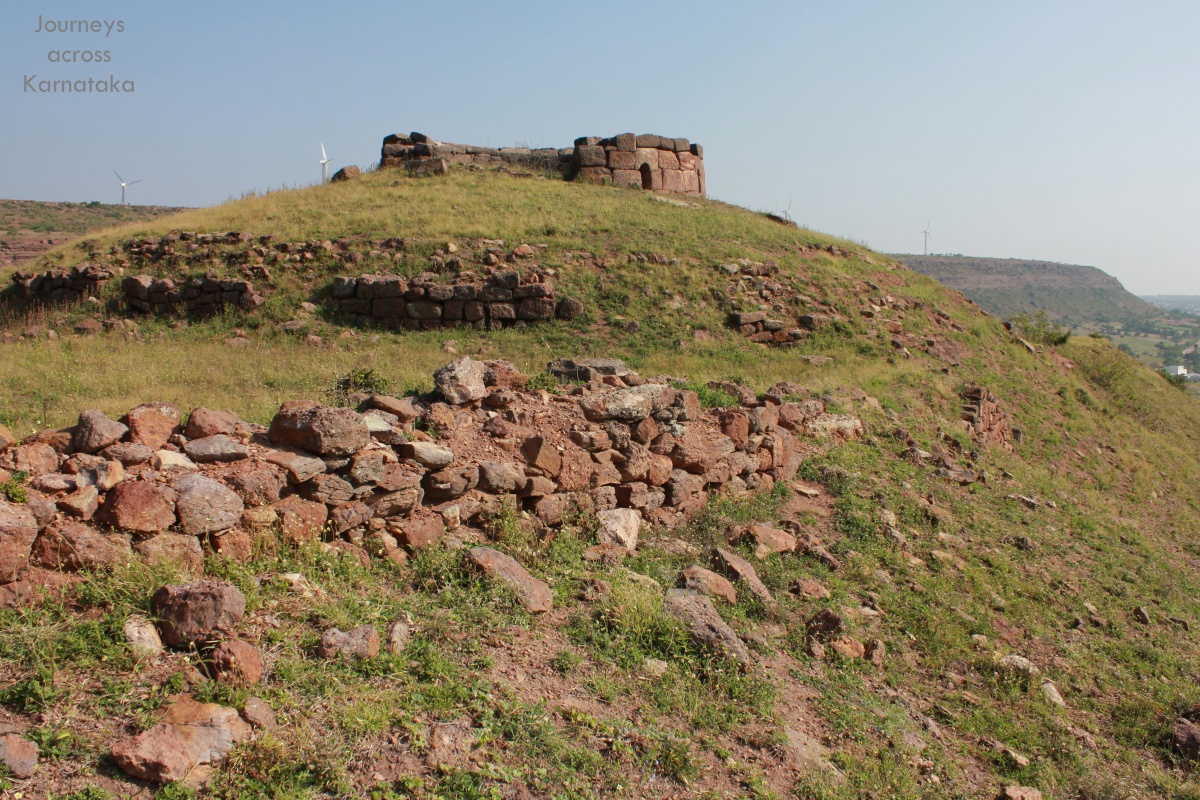
This hunt for Badami's rock-paintings had been going on for couple of years. Thanks to my friends Ranganath Juttannavar and Dhariappa.Dharegonnavar's help, a group of paintings has been located in Hiregudda barely 500m from Badami-Banashankari road. The word Hiregudda can be split into Hirae and Gudda meaning big and hill. The spot is on the sandstone hills right opposite Ranganath's house.
Sept 15, 2012
After a hectic day exploring Kutkankeri, Amingad and Aihole, we arrive at Badami and camped for the night at Ranganth's house. We had dinner and discussed plans for the morrow; one of Dhariappa's students- Pundalik -would be our guide to the spot and we would go there early, while Sun is still low. Ranganath's neighbor Mr.Satarkar an ex-ASI employee would be joining us- it would be great to have an elderly person for company. He mentioned his ignorance of the paintings existence even it was close to his house.
Sept 16, 2012
By 7 O' clock we grouped, had fresh tea at a chaha-angadi. Path to the painting passed through a residential locality.. as we walked folks gave us surprised looks. Pundalik lead us up the hill. The terrain got rough, it was littered with peek-jaali thorns. We were concerned about Satarkar's safety.
We had to reach the base of the rock, on the right corner.
At the base of the rock, ground was steep and dry with loose mud and small stones. Climbing here was a bit of a challenge; we had to be sure of the foot-hold with every step. The painting is on a flat surface about 15 feet high, marked with a circle in this picture.
That's a prehistoric drawing board. The location is quit different from the ones seen earlier, most were in rock-shelters but this is a open rock face. Wonder why this spot? Did the painters use ladders or scaffolding to reach the board?
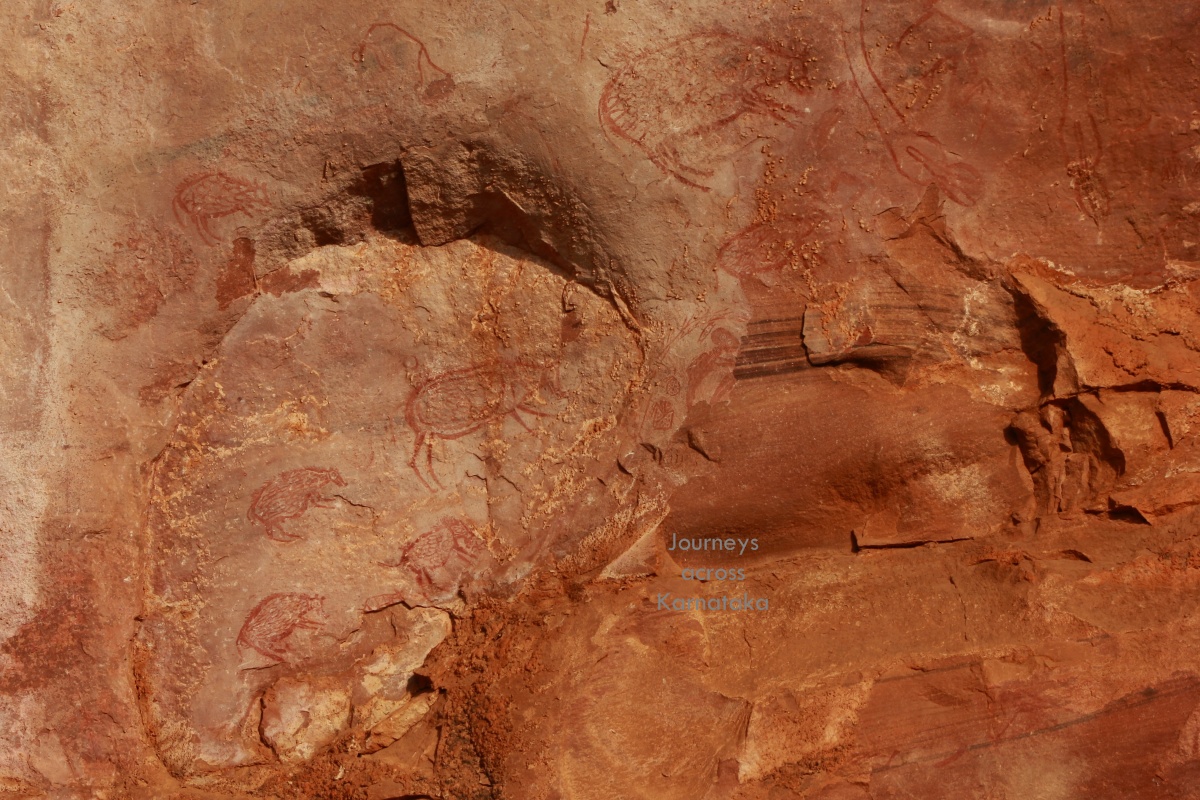
Our drawing board could be 9 feet wide by 5 feet high and faces the East. The board contains 30 to 40 individual figures painted in ocher, the only color seen here, color shade is more or less uniform. Facing east direction the board receives direct sunlight for 2 to 3 hours daily. In spite of being exposure to sunlight, the paintings have survived several thousand years. Also the painting is exposed to rain water dribbling down the rock face. The white patches seen here is a product of chemical reaction between stone and water. The other form of damage could be due to insect nests or insects laying eggs.

We'll take a closer look at the drawings. In my opinion these drawings of Hiregudda are rather unique, creatures depicted are unusual, not like the drawings of men, women or animals as seen in Onake Kindi or Kutkankeri. Hiregudda's drawings of human-like creatures and animals create a feeling you are looking at some form of extra-terrestrial life forms. Animals depicted here are some-what like pigs, boars, bulls, rabbits and mongooses. Another interesting point is the alignment of the some drawings; they are inclined, as though animals are standing on a slope.
In this frame we can see seven four-legged animals which seem like wild boars or wild pigs, but they are neither. Also at the top of the picture is a human-like figure, shoulder and heads drooping, arms dangling... seems like a dead tired person walking. Close to the center of the photo is a humanoi with a over-sized head, it seems like an astronaut.
Zooming in further, of the four creatures the smaller seem like pigs and the larger seems like a cow.
The cow-like creature. Notice the head, its very different from a cow's head. Hair on the shoulder and back are clearly visible, so is the tail. Coming to the body, did the artist try to show the creatures innards or is it a skin pattern?
Panning to the right, we see three humanoid figures; two figures closer to each other seems like a couple- a male and a female. The other humanoid is wielding stick like objects, one in each hand. Between the stick-wielder and the couple are two objects which seem like a jug and a tray. The tray could bread or a slab of chocolate or anything else. Amazing isn't it?
The couple. Though sex organs are not depicted these figures do seem like a male-female couple. The male is taller and better built than the female. The patterns on the body and limbs are skin patterns or are they attired in some type of garment? Notice two conical protrusions from the female's chest- are those breasts? Also in the picture is a headless humanoid, an incomplete picture?
Close to the female's right foot are two animals with short legs- rabbit or mongoose?
A thought here; I feel the paint used here could be blood. It's a fact that prehistoric artists used a mixture of ground minerals, crushed herbs and pig's blood to prepare paint.
Between the male's legs is another humanoid creature; the head is large with prominent eyes; body and arms have faded. Close to the male's right foot is a two legged creature.. can't say what it's like, the part of the drawing has faded.
Though these humanoids look frightful, they don't seem violent.
Stick wielding humanoid: head is covered with thick hair; small eyes; bent and tapering neck, long slender body, slender arms, well-built legs and tiny feet. A closer look at the head reveals hair tied into a plait. Is this a female? Skin has a checkered pattern and it seem like the feet are covered by some sort of shoes. The stick-like objects- doesn't seem like weapons.
Food objects: Wonder what these things are.
Panning to right, the board's surface gets rough. Also a white column covers the entire height of the board; this might be the effect of water. Sticking out of the white column is a humanoid at an inclination. The skin has zig-zag pattern. On the left is a four-legged animal. What could be the reason for inclined drawings?
I have rotated the picture for easier viewing. The four-legged creature seems like a bull; the head is small with big ears and has an extended snout, like a small trunk; tail is thick; body has a pattern similar to the cow-like creature seen earlier. The slight protrusion under the belly could be the sex organ.
The drooping humanoid: this is the only figure resembling an earthlings closely. Is it bowing down with respect or tiredness or sickness?
This creature looks like a combination of a pig, a deer and a cow. Please feel free to share your opinion. This animal has a pointed snout, scaly skin and thick hair along the spine.
The astronaut. This humanoid seems like its donning a space suit. Notice the vertical lines starting on the helmet and running down on the neck. It seems like wearing a backpack. The humanoid is holding something.. unfortunately part of the picture is missing. Oh, I just realized there's a base layer. Now it seems like the artists had painted a white base before painting the ocher drawing.
Besides the astronaut, there are three objects- wonder what they are. The rectangular object seems like a basket. The round object looks like a coconut or some sort of fruit. Everything's so different even though they have some resemblance to things on Earth.
Another humanoid: this seems like a female.. going by the figure and slender arms. This part of the drawing board is chaotic. Hard to understand.
In this frame are more humanoids resembling earthlings closely. Wonder what the long vertical object on the left is?
Are these figures actually earthlings and other humanoids are life from a different planet?
Few more humanoids in this frame.
In this frame two paintings have been encircled. I can' make out what's in the oval. Coming to the circle, its a very strange looking creature- a combination of tortoise and a bull; position & shape of the head seems like it's tortoise's. Body and tails looks like bull's. Are these creatures imaginative or did they exist here on Earth or do they exist some where outside our world?
That's the team.
 |
| Pundalik, Dariappa, Malatesh, Satarkar, Raju |
These hills still have wildlife in them and local people hunt them for food or profit. Satarkar told a story of a local lad who died on this hill few days back. The boy had laid a bird trap on a ledge. While checking the trap he had fallen down several feet. Unfortunately he was alone when that happened. The boy's relatives alarmed on his missing launched a search and found his mutilated body after a week. The boy must have died in the fall; the body was attacked by a hyena or some other animal. Kannada word for hyena is
Kattekiraba. One has to be careful in these hills, advisable to be in groups and always exercise care no matter how good a rock climber you are.
We must have spent an hour looking at the drawings. And spent some more time studying them at home. There are many questions: Who made these paintings? When were they made? Are the animals and humanoids imaginary or real? Wish I could get some answers. There are articles which mention extra-terrestrial beings in rock-paintings.
.........