Tampilkan postingan dengan label rock paintings. Tampilkan semua postingan

Prehistoric rock-paintings of Badami

This hunt for Badami's rock-paintings had been going on for couple of years. Thanks to my friends Ranganath Juttannavar and Dhariappa.Dharegonnavar's help, a group of paintings has been located in Hiregudda barely 500m from Badami-Banashankari road. The word Hiregudda can be split into Hirae and Gudda meaning big and hill. The spot is on the sandstone hills right opposite Ranganath's house.

Sept 15, 2012
After a hectic day exploring Kutkankeri, Amingad and Aihole, we arrive at Badami and camped for the night at Ranganth's house. We had dinner and discussed plans for the morrow; one of Dhariappa's students- Pundalik -would be our guide to the spot and we would go there early, while Sun is still low. Ranganath's neighbor Mr.Satarkar an ex-ASI employee would be joining us- it would be great to have an elderly person for company. He mentioned his ignorance of the paintings existence even it was close to his house.

Sept 16, 2012
By 7 O' clock we grouped, had fresh tea at a chaha-angadi. Path to the painting passed through a residential locality.. as we walked folks gave us surprised looks. Pundalik lead us up the hill. The terrain got rough, it was littered with peek-jaali thorns. We were concerned about Satarkar's safety.
We had to reach the base of the rock, on the right corner.
At the base of the rock, ground was steep and dry with loose mud and small stones. Climbing here was a bit of a challenge; we had to be sure of the foot-hold with every step. The painting is on a flat surface  about 15 feet high, marked with a circle in this picture.
That's a prehistoric drawing board. The location is quit different from the ones seen earlier, most were in rock-shelters but this is a open rock face. Wonder why this spot? Did the painters use ladders or scaffolding to reach the board?
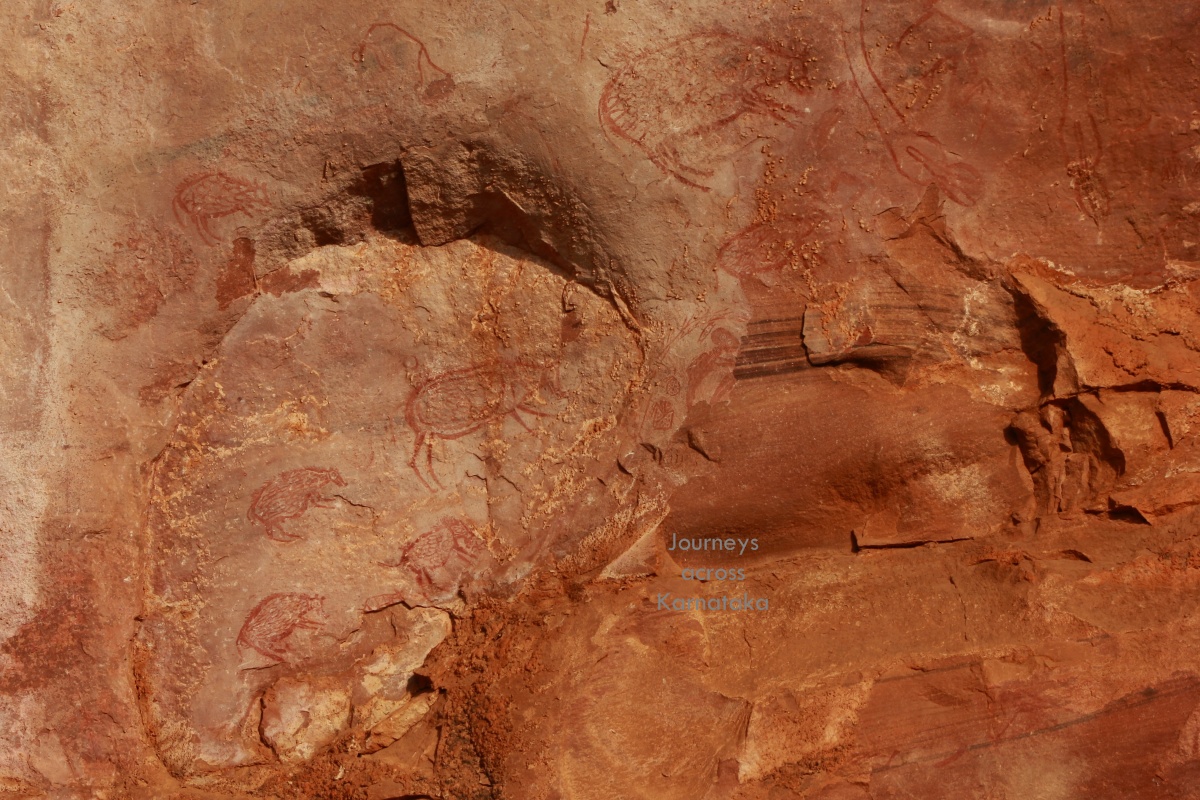
Our drawing board could be 9 feet wide by 5 feet high and faces the East. The board contains 30 to 40 individual figures painted in ocher, the only color seen here, color shade is more or less uniform. Facing east direction the board receives direct sunlight for 2 to 3 hours daily. In spite of being exposure to sunlight, the paintings have survived several thousand years. Also the painting is exposed to rain water dribbling down the rock face. The white patches seen here is a product of chemical reaction between stone and water. The other form of damage could be due to insect nests or insects laying eggs.
We'll take a closer look at the drawings. In my opinion these drawings of Hiregudda are rather unique, creatures depicted are unusual, not like the drawings of men, women or animals as seen in Onake Kindi or Kutkankeri. Hiregudda's drawings of human-like creatures and animals create a feeling you are looking at some form of extra-terrestrial life forms. Animals depicted here are some-what like pigs, boars, bulls, rabbits and mongooses. Another interesting point is the alignment of the some drawings; they are inclined, as though animals are standing on a slope.
In this frame we can see seven four-legged animals which seem like wild boars or wild pigs, but they are neither. Also at the top of the picture is a human-like figure, shoulder and heads drooping, arms dangling... seems like a dead tired person walking. Close to the center of the photo is a humanoi with a over-sized head, it seems like an astronaut.
Zooming in further, of the four creatures the smaller seem like pigs and the larger seems like a cow.
The cow-like creature. Notice the head, its very different from a cow's head. Hair on the shoulder and back are clearly visible, so is the tail. Coming to the body, did the artist try to show the creatures innards or is it a skin pattern?
Panning to the right, we see three humanoid figures; two figures closer to each other seems like a couple- a male and a female. The other humanoid is wielding stick like objects, one in each hand. Between the stick-wielder and the couple are two objects which seem like a jug and a tray. The tray could bread or a slab of chocolate or anything else. Amazing isn't it?
The couple. Though sex organs are not depicted these figures do seem like a male-female couple. The male is taller and better built than the female. The patterns on the body and limbs are skin patterns or are they attired in some type of garment? Notice two conical protrusions from the female's chest- are those breasts? Also in the picture is a headless humanoid, an incomplete picture?
Close to the female's right foot are two animals with short legs- rabbit or mongoose?
A thought here; I feel the paint used here could be blood. It's a fact that prehistoric artists used a mixture of ground minerals, crushed herbs and pig's blood to prepare paint.

Between the male's legs is another humanoid creature; the head is large with prominent eyes; body and arms have faded. Close to the male's right foot is a two legged creature.. can't say what it's like, the part of the drawing has faded.
Though these humanoids look frightful, they don't seem violent.
Stick wielding humanoid: head is covered with thick hair; small eyes; bent and tapering neck, long slender body, slender arms, well-built legs and tiny feet. A closer look at the head reveals hair tied into a plait. Is this a female? Skin has a checkered pattern and it seem like the feet are covered by some sort of shoes. The stick-like objects- doesn't seem like weapons.
Food objects: Wonder what these things are.
Panning to right, the board's surface gets rough. Also a white column covers the entire height of the board; this might be the effect of water. Sticking out of the white column is a humanoid at an inclination. The skin has zig-zag pattern. On the left is a four-legged animal. What could be the reason for inclined drawings?
I have rotated the picture for easier viewing. The four-legged creature seems like a bull; the head is small with big ears and has an extended snout, like a small trunk; tail is thick; body has a pattern similar to the cow-like creature seen earlier. The slight protrusion under the belly could be the sex organ.
The drooping humanoid: this is the only figure resembling an earthlings closely. Is it bowing down with respect or tiredness or sickness?
This creature looks like a combination of a pig, a deer and a cow. Please feel free to share your opinion. This animal has a pointed snout, scaly skin and thick hair along the spine.
The astronaut. This humanoid seems like its donning a space suit. Notice the vertical lines starting on the helmet and running down on the neck. It seems like wearing a backpack. The humanoid is holding something.. unfortunately part of the picture is missing. Oh, I just realized there's a base layer. Now it seems like the artists had painted a white base before painting the ocher drawing.
Besides the astronaut, there are three objects- wonder what they are. The rectangular object seems like a basket. The round object looks like a coconut or some sort of fruit. Everything's so different even though they have some resemblance to things on Earth.

Another humanoid: this seems like a female.. going by the figure and slender arms. This part of the drawing board is chaotic. Hard to understand.
In this frame are more humanoids resembling earthlings closely. Wonder what the long vertical object on the left is?
Are these figures actually earthlings and other humanoids are life from a different planet?
Few more humanoids in this frame.
In this frame two paintings have been encircled. I can' make out what's in the oval. Coming to the circle, its a very strange looking creature- a combination of tortoise and a bull; position & shape of the head seems like it's tortoise's. Body and tails looks like bull's. Are these creatures imaginative or did they exist here on Earth or do they exist some where outside our world?
That's the team.
Pundalik, Dariappa, Malatesh, Satarkar, Raju
These hills still have wildlife in them and local people hunt them for food or profit. Satarkar told a story of a local lad who died on this hill few days back. The boy had laid a bird trap on a ledge. While checking the trap he had fallen down several feet. Unfortunately he was alone when that happened. The boy's relatives alarmed on his missing launched a search and found his mutilated body after a week. The boy must have died in the fall; the body was attacked by a hyena or some other animal. Kannada word for hyena is Kattekiraba. One has to be careful in these hills, advisable to be in groups and always exercise care no matter how good a rock climber you are.

We must have spent an hour looking at the drawings. And spent some more time studying them at home. There are many questions: Who made these paintings? When were they made? Are the animals and humanoids imaginary or real? Wish I could get some answers. There are articles which mention extra-terrestrial beings in rock-paintings.

.........

Kutkankeri, a prehistoric site - part 2

..article continued from Kutkankeri, a prehistoric site - part 1.

This rock is known by the name Junjunpadi. The word can be split into Junjun + Padi. Junjun is the short form for Junu Junu which is an expression for anything that feels chilly. Fakirappa said weather under this rock is always cool, sometimes cold hence the name Junjunpadi.
The approach ramp is scattered with rocks.. an abandoned plan to make steps like we saw some time back. We climbed about 20 feet to reach the natural rock shelter.
A spacious, comfortable shelter. Fakirappa's nephew Rangappa joins us. He's taken a short break from cultivating his fields with a pair of oxen. Minutes later another relative Basu joins in.
The shelter gave a commanding view of the plains below. Approximately a kilometer from here, beyond the plains, is another hill range. To the right end of the range was a big cave. Fakirappa confirmed the existence of a cave. I asked if we could go there.. Fakirappa said the cave smells bad because of decaying remains of carcasses and bones left over by  Kattekiraba. So that cave is hyenas' den. I said we'll go there some other time... perhaps we should go there in a larger group armed with long sticks for self defense.
At the entrance is one painting of a horse and two men.
The men seems to be wielding swords and shields. The man seems to be standing on the horse back rather than being seated on it.
Ten to fifteen feet into the shelter is another painting. This seems to be a battle scene; men wielding weapons and riding horses
Basu, Rangappa and Fakirappa. The boys are wondering why we wanted to see these paintings.
About 40 meters away is another rock shelter.. now its shrine for local folks. Here we could see the entire surface covered by ocher, most parts have faded and difficult to identify what was depicted. To add to it local people had smeared sunna lime in circles.Fakirappa said that its a smearing lime is a part of the ritual. However, he was not happy about the paintings getting damaged.
One part we could see clearly was here. This seems to be a plant, perhaps a bunch of buds and flowers. The painting on the left seems to be a horse.
Wish I could know what these lines depict.
We decide to on. We climb again, we come here to check out another rock shelter. It was inaccessible.  Fakirappa demonstrates how a cactus' long pointed leathery leaves were used to make rope. He pucks a leaf, peels off the outer layer and thrashes it on a flat surface to separate the fiber in it. But this is not the right procedure., he says. The process involves soaking the leaves overnight, then clear off the pulp from the fiber, dry them and weave them into ropes.
At the summit, a huge mound came into view. This would have been a great watch tower during prehistoric time.
Close to this mound I saw three stones lying close to each other. I felt they were one stone; Malatesh and Fakirappa placed them in position. Yes, it was one stone measuring about 6 feet long and a feet wide, tapering at one end.

A mini shelter. Right besides Malatesh, you can see vertical and horizontal crack lines perpendicular to each other. They seem to be have been drawn.. but no they are natural.
What came next was unexpected. Fakirappa showed us remains of a vandalized megalithic burial chambers. There were three of them within a 150' diameter circle.
Fakirappa said that people believe these to be Muslim graves. I told him the fact that these graves are made two to three thousand years ago, they cannot be Muslim graves.
A recently dug pit.. treasure seekers' deed. The graves are completely damaged :(
We start climbing again. I could see Malatesh was struggling, I guessed hot weather was affecting him.   This part of the hill was littered with stones... no where on these hills had I seen anything like this. Was this a quarry?
At the hill top was another plateau. Another surprise; ruins of ancient stone structures. I remember seeing three or four such ruins in the close vicinity. So these stones must be from the place I suspected to be a quarry (see previous picture). There was evidence of recent digging, obviously treasure seekers work.
Fakirappa is proving to be one resourceful guide; so far he's shown us an amazing rock formations, prehistoric rock paintings, megalithic burial sites, and ruins of ancient houses. Now we are standing in front of a shrine where newly weds come and make a wish. During a particular festivals families come here with pooja and food items, perform pooja at the shrine and have food. Now the interesting part is how food is eaten. Plates or leaves are not used. A flat spot on the ground with a slight depression is selected (see inset). The spot is washed clean with water. Food, usually anna, saaru, palya, uppinkayi are served on that spot and eaten. Down to Earth custom. Some different, right? We scoured the surroundings and identified many such spots which served the purpose.
Kutkankeri is surprising us so often now.We are looking at underground fresh water pond; it is called as Aryara Baavi. Fakirappa explains that people believe that Aryans once lived on these hills and this was one of the main sources of drinking water. Hence it is called Aryara (Aryans) Baavi (well). Below  the ground we are standing on is hollow. Water is available through out the year, even during drought. I noticed a big patch of lush green grass about twenty feet away. Grass is green where there's water, right?
Fakirappa bends down and checks the water, tastes it and then drinks some. I too tasted Aryara Baavi water, it was fine but did not swallow it. Surely my tummy is not as strong as Fakirappa's.
We meet Fakirappa's uncle again; perched on his seat high up he watches his herd grazing peacefully. In a way this hill is his kingdom. Malatesh cools off his head with this water. Notice stones on the left? It's a micro dam, it stops rain water from running off and creates a small pond.
Now we start climbing down, I was kind of relieved that it would be easy for Malatesh. Fakirappa shows more sources of fresh water close by. Water is stored on cracks and crevices in rocks. Here, I see something very strange; a circle in stone. This 2½' diameter ring's rim is 2" wide x.5" high. This doesn't seem man-made. Then how is possible to have formed naturally? Fakirappa has no idea what this is or how this was formed.
A closer look at the ring. This looks like a stone ring was welded to the rock.
One megalithic burial chamber. On these hills we saw totally eight burial chambers.
Our tour was coming to a close. Last on the itinerary was ruins of a fort and few rock paintings. This picture is just outside the fort, close to the fort entrance. It's a very small fort, the perimeter could be less than a kilometer.
Inside the fort are these two massive rocks. Malatesh and Fakirappa are inspecting paintings, sadly they are vandalized by some college boys.
 
Painting depict a human form and an animal which looks like a tiger. Those vandals did not find any other place to post a love message for their girls.. GRRR One consolation, it wan't paint but lime. We tried to wash the lime off with water. After emptying on bottle we realized we'll need buckets of water and a soft tooth brush. perhaps we'll go back there one day and remove the lime. I hope those vandals realize the damage they have done.
Another angle of the rock. Behind me was a rock shelter, it was cool inside. We rested there for a while, had cookies and water. The village was in view now, we'll have to walk a kilometer to reach the village square.
The rout to cillage passed through fields, we walked through standing Sajji crop. We stopped at a field being watered by sprinklers to quench our thirst. Fakirappa picked up fresh Alsandikayi, we munched as we walked back towards Kutkankeri village. Back at the village square, we realized it was 2-30, we had explored five and half hours. Not a minute was wasted, we got to see more than we expected. Thanks to Fakirappa :) Oh one last thing, we had not seen two paintings from our print out. Fakirappa suggests us to check out Gund-Hanumappa a minute's drive from where we stood. We ask Fakirappa to join us for lunch but he declines. We exchange numbers and said bye. We head towards Gundu Hanumappa.
A Neem tree with hollow trunk.
Gund-Hanumappa is a 50 feet high.rock with a natural shelter at the base. The shelter is a shrine dedicated to Lord Hanuman. The shrine walls have been whitewashed with lime.. if at all any painting existed, they are nicely tucked under a thick layer of Sunna. Disappointed we move on in search of a nice shady spot for our lunch break.

.........
Older Post ►
eXTReMe Tracker
 

Copyright 2011 Journeys to temple is proudly powered by blogger.com