Bhagawathi Tea Estate


I got permission from my Dad to go on a business (actually a service trip) with two uncles and a service engineer to rectify a nagging problem in a weighbridge supplied by our company, EFGE Load Cells to Bhagawathi Tea Estates, Wynad, Kerala. EFGE is pronounced FG, which means ‘foil gauge’, a delicate little strain sensor.

We left Bangalore in our HM Ambassador Mark III by 6 30 pm heading towards Mysore. On the outskirts my uncles picked up few beer bottles. After a while, one of my uncles, handed me an open bottle and asked me to have. What?? I was like… Anyway, I tasted the cold beer and liked it. I went real slow. I enjoyed my first bottle of beer. We broke our journey at Mysore and decided to continue the next morning.

The next morning, we had dosa for breakfast at a real tiny place in the narrow streets of old Mysore city. The dosa just melted the moment it landed on my tongue. This is the most memorable dosa I ever tasted. We got with our journey… Gundlupet, Sultan Battery… and we reached Wynad some time afternoon. The weather there was hot and humid… typical for a tea estate. I guess we did not work much, may be just a cursory check of the weighbridge. That night we had wine, and I had some and liked the taste. The color was wonderful and taste was excellent. As it is, grape juice was one of my favorite. We had a good dinner and peaceful sleep in the silent hills.

We started the new day with typical Kerala style tea served in glasses and after a while was Kerala breakfast. I think it was ‘Pattu’ with Bengal gram and 'Appam'. Every morning our guest house cooks served us different dishes of Kerala. Real expert cooks they were. For me it was more of a holiday… while my uncles were trying to sort out the weigh bridge problem. I walked around the estate through the tea shrubs, up and down the slopes. From one point I looked down towards our guest house and then to its left further down the hill, a little stream flowed in the valley with little houses next to it, children played around while the women washed clothes in the stream. Typical story book scene it was.

This is where I first saw tea leaf picking. It was a women’s job, they carried huge woven cane baskets on their backs and dropped leaves into them as they chose and picked the leaves from the shrubs. Once the baskets were filled, they carried them down to the factory area where the leaves and weighed and wages paid accordingly. One of the days, the factory manager showed us around the plant. It was interesting to see how raw leaves were washed, dried, dehumidified and turned into dust and then graded and packed. The place was full of managers… AM, DM, EM, FM, GM, etc. I can recall few; Accounts, Deputy, Estate, Factory and General.

Not sure if it was the second or third evening at the estate; we were invited to the GM’s bungalow for drinks. Whisky was offered and I declined it, I was not sure if I could handle it. The GM was an ex-army person and cordial to us. I think, the same evening, my uncles decided to go to a nearby town to fetch drinks and on the way back a big stone hit the underside of our Ambassador damaging the oil sump. Back at the guest house, the booze session was little wild with one of the uncles in real high spirits.

Work on the weigh bridge was going nowhere and the managers were getting impatient with us. After several rounds of discussions over phone with my Dad, it was decided that we head back home, leaving the job incomplete. Somehow nothing was going well… no progress on work, bad remarks from the customer and a damaged car. Our journey back home was a real drag; because of low oil pressure the engine was damaged and we drove real slow... litreally limped back.

If not for anything else, this trip introduced me to the world of booze. I had the confidence to handle it while most of friends had not even touched it. Now, I'm a teetotaler.

………

Bannerghatta on bicycles


Skanda, C V Nagendra, and I planned a trip to Bannerghatta, a 22km ride, in the first week of our summer vacations. This would be our first trip outside Bangalore on our own.

I had an Olive Green Humber Bicycle and my friends had one Atlas and one Hero. We planned a great deal and worried what we would do if we got a flat tire or a brake failure as they were a big problem!

We packed bread and home-made tomato jam and water in bottles. We left early, riding leisurely occasionally stopped by to catch our breath. Beyond the city limits, road was flanked by woods. It was peaceful and the air was fresh. The peace was occasionally disturbed by the traffic; smoke bellowing KSRTC buses or trucks laden with sand, granite or bricks. We reached Bannerghatta by 10 or 10 30 and we had breakfast. We spent time looking around the zoo and then we left to the small granite hill near-by. We explored the small granite hill near by with an ancient temple at the base (this was my second visit). By 3 or 3 30 we decided to head back home. We reached home safely and without a flat tyre... not really an adventerous trip.

Now, looking at the traffic now on the same stretch of road, it’s a complete contrast. The jungle now is a concrete jungle, peace replaced by the noise of traffic and air filled with dust kicked up by the vehicles. How modern man destroys tranquility in the name of development!

………

Annie Besant Park

It’s a permanent venue for NCC camps. I spent 11 days here with my friends and PUC I class-mates from PES College. This was an opportunity for us to learn life away from the comforts and luxury of home. We reached Doddaballapura by train and from there we were transported to the camp area by one of the military trucks.

Tents big enough to accommodate 15 grown-ups were pitched in a huge square with a quadrangle in the center. Every tent had a snake pit around them. The first day, we were read out the camp rules and allowed to settle in our respective tents. We explored the park out of curiosity. Found a couple of bore wells and water taps, our source for water to drink and wash. We discovered there were no bathrooms or toilets, Indian Army wanted us to be real close to nature.


This was the first time I slept in a tent, with just a mat on the earth. Wind was blowing like crazy through the night and our tent had a nice tear in a corner, right next to me. I hardly slept through the night. The next morning, we were woken up early. It was cold and we had to wash with cold water… ooohaaahah! What an experience!

We all assembled in the quadrangle, dressed in our uniforms. We went for a cross country jog and then exercised, after which we had a short break during which we had breakfast and relaxed. Then came the drill session… attention! Baye mood! Dhaine mood! Piche mood! By the left quick march!! left-left-left-right-left... look straight, swing your arms high, left-left-left-right-left... keep your knees straight, dig your heels into the ground… Oh man! The Gurkha officers made us spend double the energy of what their food gave us. The sessions never seemed to end. Most of us were just waiting to hear 'squad-halt!', 'stand-at-ease' and 'disperse'. We were served three meals a day and we could choose between veg and non-veg. Food was no way near to home food but not bad too.

Most of the officers were friendly but strict. I remember there were three ‘Chatri’s. And in our college group, there were three Prasads. Babu Prasad, Skanda Prasad and me. The Gurkhas asked us if we were cousins and we asked them if they were brothers. My other tent mates were Gurudutt M P, Ramesh P, Bharath, Sridhar...

One morning, our officer made us jog down to the Doddaballapura Railway Station, it was a deserted little place with hardly any activity. We exercised on the tarmac road with a few local people watching us with amused expressions. On the way back to the camp, again jogging, we stopped every half kilomater and made to push ups or sit-ups or any activity to sap our energies out. Most of us were hungry and just waiting to reach the camp food area. What a morning that was! The camp was not just drills or exercising, we were given tasks to make us get used to hard work like watering plants, levelling the dirt path within the camp area for which we had to dig with spades and move dirt from a near by spot. We fetched water from a bore well and sprayed the dirt path we had repaired. The officers never ran out of ways to kep us busy... One of the nights, four of us were asked to watch the food material store room. I remember how we struggled to stay wake in the cold weather till morning.

After a week or so, one after-noon, I got a surprise. Dad, Mom and Dipi had come to see me. They stayed for few minutes, 15-20 minutes and left. Dad gave me a bundle of snacks which got over in no time.

One of the days, a day trip to the near-by Nandi Hills was organized. We were dropped off on the main road at the base of the hill, given breakfast and asked us to take the road up. A 8km trek. It was fun! We made it to the summit in about 2 hours. We explored the hill and it’s fort and ruins and assembled back at a pre-designated time and spot expecting the trucks to be there to take us down. No! We were asked to climb down the steps!! Most boys started complaining pain and few experienced cramps by the time we reached the base. That was not the end, we had to trek 4kms of rough terrain to reach the trucks. With the sun blazing down, mouths dry and stomachs growling… You are in the army now!

Our camp had a small open air theater in natural settings with granite slab benches for seating an audience of about 300. The stage area was sheltered with Bougainvilla creeper and other small trees. On the tenth evening, couple of senior army officers were present for the closing… not a ceremony, whatever you call it …who gave away prizes and gave short speeches. I revisited the place sometime 1996 with Gulli.


No beds. No electricity. No hot water. No bath for eleven days!! When I got back home, my hot water bath lasted one hour.

………

Naldurg Fort

Riding between Bijapur and Bidar (I think some where after Solapur), Gulli and I stopped by to talk to these local kids. I think they were walking back home from school. We passed by this massive Naldurg fort... I regret we did not venture inside. Hope to visit this wonderful looking fort some time in the future.


That's my Hero Honda Splendor. Great bike it was. We got 70+ kilometers per litre of petrol riding mostly between 50 to 60kmph and occassionaly touching 80. My Spledor was smooth, effortless and efficient through out our 13 day trip circling Karnataka covering close to 3000km. Not even a flat tyre.


.........

Ghati Subramanya

Travelling back in our loaded Maruti Omni from Kurnool with Dad, Praveen and Anish, we decided to visit Ghati Subramanya while having tea at a dhaba at a fork on NH7 just after Penukonda. The national highway led to Bangalore, while the branch, a state highway went towards Hindupur, Gauribidnur, Doddaballapur and joined NH7 at Yelehanka. Somewhere between Gauribidnur and Doddaballapur, we left turned into a smaller road leading to Ghati Subramanya. After about 2km, we saw a group of boys lugging survey equipment, as we neared them they waved at us for a lift. I was not willing to stop but on Dad’s command we asked the civil engineering students to squeeze in along with their equipment. The loaded Omni was overloaded now… nine adults and lot of material. …the rear doors had to be left open.

As we crawled up the hilly section of the road in first and second gears, Dad went back to his engineering days at UVCE … told us how he and his classmates spent 5 days surveying the hills. Those days, 1960s, survey was a part of the 5 year course. He’s had one hell of a time! We dropped off the boys at the outskirts of the town close to a dormitory where they were put up and we went straight to the temple. I think we had to wait to for 30 minutes for the temple doors to open.

Inside the temple, close the sanctum sanatorium, we stood with other visitors. Dad and Praveen were in the front. Anish and I stood at the back behind a couple, the wife holding her 2-3 month baby looking at Anish with it’s cute little eyes. I was trying to be serious while Anish found the baby amusing. He started making faces at the baby and asking me look at it making faces in return. Serious! The baby would stick its pink little tongue out when Anish stuck his tongue out. I was little worried, what if the husband saw and mistook that we were trying something… The sound of bells during the Mangala-arathi finally distracted Anish from the baby.

The temple is not a very big structure but the mythological story behind it was quite interesting. The story revolved around the Garuda and snake; the reason for their enmity and all. Any time in the future, if I ever recall the story, I’ll post it. People would visit this temple to offer a silver snake idol to the temple, perform pooja and seek blessings to wash away the sin acquired by harming or killing snakes. Once out of the temple, we headed straight to a mobile cart shop, had bajji & tea and then started towards Bangalore.

During this trip, we had one helluva time. Our journey; Bangalore-Chilamkur-Kurnool-Ghatisubramanya-Bangalore. This was my first venture into the interiors of Andhra Pradesh and I was amazed at the state government’s effort into rain water harvesting… lakes after lakes. While travelling between Chilamkur and Kurnool, we took a small detour to visit a small dam and reservoir; sorry again, I cannot recall the river’s name. We saw hundreds of dead fish floating…

Andhra is beautiful, similar to Karnataka in more than one way.

………

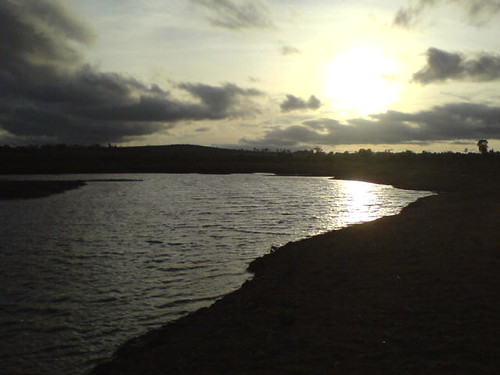
Sunsets at Bokyapur Lake

I was lucky to see these wonderful sunsets on three different evenings.


.........

I agree with this


Do you?

..........

One more sunset at Bokyapur Lake

This is on a different evening.


.........

Coracle ride in Kali river

December 31, 2006

My second ride in a coracle in a major river. Kali, the river is akin to the name. In this two kilometer ride, first we pass under an ancient bridge, pass by tiny islands on which people actually live, saw crocodiles, passed through mild rapids and finally reached the bank with lot of cover from trees with branches touching the waters.


You should try this once. Jungle Resorts, Dandeli, Karnataka.

.........

Ramakrishna Ashram, Bangalore

Mom and me spent some time in this serene place. The garden is well maintained with lots of colorful flowers. I snapped up a few pretty flowers...


.........

Kumbhakarna

We used to see this unique creation (while under construction) on the way to Kurnool. It was located between three hillocks, next to the highway just before Anantapur. We stopped out of curiosity and were amazed at the sight.

This is an attempt to create the scene from the mythological story Ramayana; awakening of Kumbhakarna, the brother of the powerful demon king Ravana. According to the story, he was huge and was cursed to fall asleep immediately after a meal. Demon soldiers are trying to from his deep slumber using all possible ways… drumming into his ears, elephant prodding his head, pulling hair, poking with spears, tickling his sole, pulling hair, trying to get the aroma of food into his nose… The imagination is just too good.

We learnt from one of the workers that this is would be a restaurant under Andhra tourism department’s management.
This was the only visit to the place. Hope to see the restaurant some day.
………

Kotilingakshetra and Bethamangala

After a hard day's work at BEML, Kolar Gold Fields, commonly called as KGF. Deepak, Praveen, Ajay, Kalu of Komal Process Controls and, Kamal of Epoch Instruments and I we went to Kotilingeshwara. The place is full of Shiva Lingas… as the name goes ‘Koti’ means ‘ten million’. The place is supposed to get filled with that many Linga.
There’s also a giant Basavanna or Nandi made of cement. Aesthetically it’s not pleasing… the proportions are not correct.
We spent some 30 minutes and moved on to Bethamangala, to see the water purifying system which supplies water to BEML and KGF.
This plant, next to Bethamangala lake, was supposed to have been constructed 100 years back by the British government. Even now, the plant works well.
The care-taker showed us around… the entire purification process. It’s truly an amazing place to see. It’s a monument by itself.

I regret I did not have a better camera.

.........

Kurnool and Alampur

Kurnool was one of the destinations I frequently visited in Andhrapradesh during the 90s. The town’s situated on the east bank of river Tungabadhra. Incidentally the city is only on the east bank. On the west bank are the industries of TGV group.

During one of the visits, we went for a walk in the river bed. Rivers in Rayalseema belt are mostly shallow and wide. The bridges across the rivers are long. I’ve hardly seen rivers flow in this region, except for this one- Tungabadhra and Krishna.

It was a summer evening; the breeze was refreshing after a day of traveling from Bangalore and then work at one of TGV factories. As we entered the river bed, we noticed musk melon creepers… it was towards the end of the season, most of them were dry. The Kurnool variety musk melon is very popular.

Walking on dry sand was fun and needed lot of effort. As we approached the waters, I noticed this lovely little anchor. It was beautiful!


Wondering what an anchor is doing here? Small boats are used here to ferry people across the river from the town to the factories. I rode one of the bigger ones, powered by a diesel engine, couple of times. The route was a round-about one since it had to be navigated through the deepest parts of the river.


In the picture above, you can see a part of the ruins of the fort supposedly built during Tipu Sultan’s reign. Kurnool has its place in Andhra history.


During another visit, we decided to check out other historical monuments within the city. This one is a small structure built like a fort, it's called as Kondareddy Buruju.


The windows are carved out of single slabs of stones.


Look at the walls and the floor… they look solid.


We spent some 45 minutes looking around. We could get a 360 degree of the flat city. Kurnool’s and Davangere are two towns which are real flat.


During the same visit, we heard about Alampur, a little temple village about 22km from Kurnool. We got see few temples, a mosque and almost dry lake bed.

One of the temples in the outskirts of the village was not originally built here. It’s shifted from another village which is presently under the waters of a reservoir. ASI has put in lots of efforts into this project; mark every stone and dismantle the temple, shift the stones and assemble it back at Alampur. In fact, Alalmpur has lot of historical importance.


The sculptures are beautifully decorated with floral and geometrical designs. Every sculpture tells a story from the Hindu mythology. In the picture below, you see a half man-half woman figure in the entrance of the temple. The guide told us a story behind the temple but I cannot recall any of it.


This temple could be one of the experimental temples.


And this snake god carving (which was lying out on the street) is supposed to have been to Paris and back for an art exhibition. There’s a small museum too with a small collection of stone sculptures.


We were almost done and we were passing the mosque within the temple complex and we noticed a huge cane basket inverted over a platform. Out of curiosity we asked a kid what was under that? Chicken? Out of no-where a bunch of kids were on the scene and a Mullah cam and moved the ‘cane basket’. Wow! I was awe-struck seeing a bowl carved out of black granite.


The Mullah told us that during festivals, this bowl would be filled with food and people would have handfuls out of it. The carvings on the sides are intricate. This picture does not tell much, you have to see it live. If not for anything in Alampur, you have to visit the place just to see this stone bowl.

.........

Chikkasiddarabetta


Satish, Anil and me came here some time 2003. We left Bangalore early morning by Satish's Santro, took NH4 towards Tumkur, stopped for idlis at one of the road-side restaurents and parked the car in one of the petrol bunks. We crossed the railway tracks and walked to the hill. Took few pictures of a tree with thick-petalled red flowers.


We talked about college days; adventures, mad driving, friends... As we climbed the hill we spoke more about the hill. What it was like some years ago. There's a small fort wall on the top. The path to the top was littered with discarded plastic bags and chicken feather. There's a tomb of a saint close to the summit. People of a particular community visit to pay respect and pray. These piligrims cook there.


It was not possible for us to reach the summit since we had to do circus... I mean climb steep faced rocks. This hill seemed to be a kind of a watch tower for Paleger soldiers. There's two a small stone structures; one within the huge rocks and another one built on one of the edges. The fall is a couple of hundred feet deep.


That's Anil kneeling a feet away from the edge and acting as though he's falling. Satish was screaming at both of us.

Check out this natural Bonsai on one of the structures.


Standing on the edge was fun!


We saw a passenger train pass by on the railway line and traffic was busy on NH4 which runs paralell to the railway line.


The entire area is full of rock covered hills. We could capture a hazy shot of Shivagange which is close to this hill.


We explored the top and found that lot of rocls had a peculiar shape on the bottom side. We wondered if it was the effect of the wind... Later, during my visit to Thenginkalbetta I learnt that this is the effect of soldiers rubbing their swords on the rock to sharpen them.


The sun was up getting warm. As we explored, we stood at an edge and could see the shadows formed on a rock below. It was fun to shoot it. The three of us in shadow...


and in real...


It was a nice little trip to mark our other trips and wild adventures.

.........

Shivagange

Shivagange. The first hill I ever climbed right up to the top.

Shivagange looks like a 'Shiva Linga' as seen from the NH4 (before Dobbaspet). I've heard it also looks like a bull's profile from another angle. When it's cloudy th top part of the hill is covered in clouds giving it a heavenly look.


The first time I had been was with Anish and Praveen but we stopped half way up since it was getting dark. The nect visit was with Gulli and we were determined to reach the top. The climb is not really tough. It took us some 90 minutes (eventually, on the thrid or fourth climb we made it to the top in 45 minutes).

The climb is a mix of both dirt and rocky surface unlike Savandurga which is all rock surface. As we pass the half way mark, the climb gets steeper with hardly anything to hold on. This part can be dicy during rains. Grass and small shrubs are the only plant life... no trees on this hill.

Just before we reach the top, we get to see Nandi statue on our left. It's perched on a small rock which acts like a private little mount for Nandi. Once on the top, you can see a small temple and a shop, managed by the Swami and his son.


The Swami's been living there for more than 20 years. What a life! On top a hill breathing fresh air and seeing the sights we rarely get to see.


The summit is a small area with steep faces on three sides. We have to watch where we step. One wrong step... let me not imagine further.


One of the faces is a suicide spot... straight down several hundreds of feet. This is where Shantala, King Vishuvardana's wife, had jumped to her death. I stood two feet from the edge and took the picture you see below.


When we looked around, we could see lot of smaller hills spread around. Many of them with little forts or watch houses on top. Palegars used these hills to keep watch over their territory and also as hideouts during wars. This whole area is one destination for nature lovers, adventure seekers and wild life enthusiasts but it's changing fast with the so called 'development acticities'.


For people coming from Bangalore, there are two routes to reach Shivagange. The most travelled route is the one from Dobbaspet. the other one is from Bangalore-Hassan road which is less crowded. We always took this road which passed through country road. During one of the visits, on the way back, I saw a flock of vultures. This was the first time I ever saw them so closely. Huge and ugly and scary. The flock was a mix os all sizes and ages.  They were busy feeding on a carcass... may be a cow or a buffalo. At first they did not notice us. I took out my aim-n-shoot Yashica and slowly went towards the flock... scared where they might attack me with their claws and beaks. But they were suddenly alert. They saw me and started leaving moving me away from me. I interrupted their party. Sorry guys. The next scene was some thing I'd never seen. The vultures started running picking speed, flapping their massive wings trying to lift their mass of the ground and then slowly took off the ground... like jumbo jets. I don't think I'll ever get to such a scene ever again.

Shivagange is a home to several temples. One of the temples is popular for it's underground spring. People throng here to touch the water which is supposed to be holy.

I've heard that a tunnel existed long time back which connected to Kashi. Hard to believe. I've also heard that another tunnel connected Shivagange to Gavigangadhareshwara temple, one of the cave temples in & around Bangalore. I've seen the tunnel's enterance at Gavigangadhareshwara temple. It was blocked after few treasure hunters died of suffocation. The temple is worth seeing.

If you ever happen to visit Shivagange, make sure you carry sticks to scare the red-faced monkeys. They are rude. Last when I went, some time 1993, they ruled the place.

.........
Detail: Shivagange
◄ Newer Post Older Post ►
eXTReMe Tracker
 

Copyright 2011 Journeys to temple is proudly powered by blogger.com