Tampilkan postingan dengan label Bagalkot district. Tampilkan semua postingan

Akkargal fort

I had located this hill fort mid 2012 in Wikimapia and marked it as unknown fort since there was no village marked close to it. The hill was about 8 kms from Pattadakal on Pattadakal-Layagundi road. The stretch of road next to the hill ran parallel to river Malaprabha.

February 23, 2013
It was around 12-10 when we left Maliyavvana Gudi. Five minutes later we driving slowly by a hill to our right, the hill was being quarried heavily. As we drove towards the neighboring hill I saw a mile stone- Pattadakal 8 kms. Yes, the fort must be on that hill.
It was better to confirm before climbing. We saw a man in the fields, he confirmed the existence of fort on that hill. We asked if he would show us the fort.. Yes. Our friend's name is Banneyappa Kabbargi. This is half way up the hill; that's river Malaprabha and on the left bank is Banneyappa's land.

I had located the unknown fort but I forgot to ask the name. It was Malatesh who popped the question to our host. Akkargal fort was the answer.

This is a diagram of the spur of the hill on which Akkargal fort is situated. Actually the hill is quite big and the elevation of the spur is about ¾ of the summit.


The climb lasted little more than 10 minutes. This tree was the first thing came into sight, it is situated within the fort close to the south-eastern border.

Under the tree is Hanuman temple. The structure is in dilapidated condition, rituals are performed occasionally.

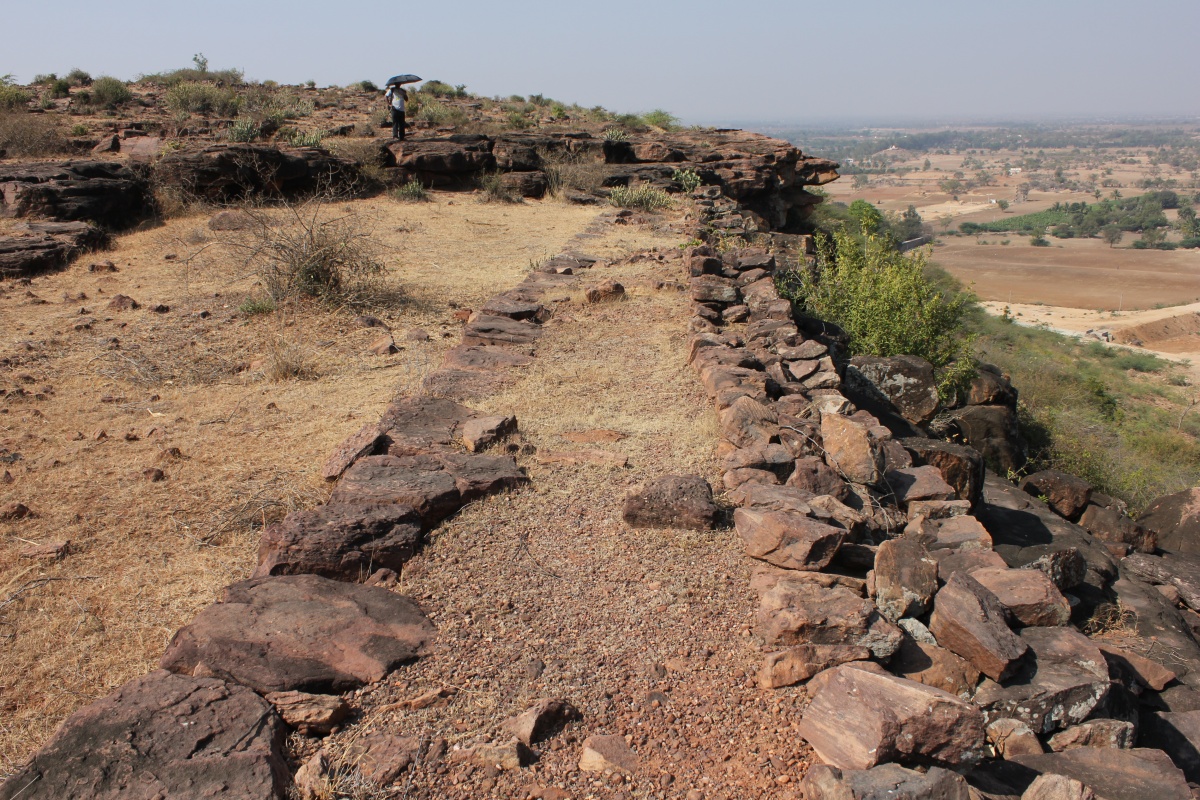
Within the fort are ruins of several small structures which were homes log time back. This is very similar to the ruins seen at Guledgudda fort earlier today. Some of the walls are well preserved, small cubical pockets can be seen in many. We found a grinding stone (see inset).

The plateau isn't exactly level surface, rather its a sloped surface. Within the fort is a elevated  part on which a small tower is built. Banneyappa is standing inside one of the houses. These stone-walled houses might have had earthen roofs supported by wooden beams. Banneyappa tried to identify the room; this might be a kitchen, this might be a store room, etc. We could see the houses were 2 or 3 or 4 roomed, small houses. I think back then there was no concept of bedroom, people slept in living rooms but had kitchens and store rooms.

Banneyappa said people who lived here would go down to Malaprabha river to fetch water. He must have heard this from his elders- people would hold a handful of soaked grains, the would have them while going downhill and come back with pots of water :-)

We went near the tower, the presence of fresh rubble around it confirmed it was disturbed recently. We climbed up and to our shock there was a deep pit. Definitely work of treasure seekers. We analyzed the work; a group of 15 to 20 people armed with crow bars, spades and bowls have worked through the night, mostly during a full moon. The pits base was sloping with one corner having a man sized pit- most probably the treasure was in that pit. Well, the thieves' handiwork has given us a glimpse of ancient construction methods.

View of the fort from the tower; the temple tree is sen to the left.

This is the northern wall. To the right is a kolla ~ narrow valley.

Looking in the direction of the tip of the spur.. we'll be heading in that direction. We climb the wall and get down..

..and come to the edge of the plateau. Near the mouth of the valley is a man-made pond to capture rain-water gushing down these slopes. A large earthen dam was constructed by the government. However  Akkargal folks felt the presence of the dam is a danger to their lands. If the dam breaks when full, water would rush straight into the lands below and wash away everything.. crops, equipment, etc. So to prevent such incidents a relief was provided at one side, that way the dam would retain water until it reached a fixed level and let out excess water.

These hill are grazing grounds for shepherds and cattle herds. In fact Banneyappa has spent many a years grazing his cattle here. These hills provided variety of berries, fruits and water. In fact we saw few seethaphal ~ custard apple trees; after a rainy season those trees will be full of fruits.

In this picture, the space between the two jutting portions is the fort entrance - that's my guess. The  passage has steps through it, partly natural and partly man-made.

As we descended into the passage, we could see shelters on both sides, they are sentry posts. Under the shelter on the left is a small platform, perhaps it was built to reduce the gap between the floor and the ceiling- that way the shelter is more effective.

On the right is a series of outcrops, they look like teeth in a canine's mouth. Malatesh and Banneyappa have already settled themselves on a rock.
Banneyappa is telling about people taking a path through this hill to Layagundi. They would walk about 5 kms one way to the market and haul back provisions for the week - that was many years ago. Now people go by buses.

Banneyappa is a kind man. He lives with his wife; God has chosen not to bless them with children.

Behind me was this formation. It has a small seat, a good spot for a sentry post. The guard can remain hidden too.

 Few centuries from now this bit of rock will give away and the formation would collapse.. i.e. if man doesn't get it before Mother Nature gets it. The break in the shade cooled us renewed our energy we made our way down. It was lunch time, Banneyappa showed us to a spot in his fields and gave us a mat to sit on. Our home packed lunch was jolada rotti, soaked cereals, salad, chatni and curds. Bannayeppa declined our invitation to join us for lunch; said he had finished lunch just before our arrival. We thanked our host, noted his address and promised to send his photo.

We saw this helipad rock formation on the other side of Akkargal hill. If it was early morning, I would have climbed up to get a closer look. It's beautiful, isn't it?

About a 3½ kms from Akkargal hill we saw this structure situated on a rocky hillock to our right. The structure seems like a temple, that can be confirmed only after a visit. Heavy quarrying activity can be seen around the hillock. I just hope the historic monuments survives as it is.

On the itinerary of the day were two more hill forts- Shantagiri and Kodathgeri. Considering the time and the distance to be traveled it may not be possible to cover both.

.........


Mahishamardini temple near Layagundi

About 4 years ago during a trip to Aihole, at a snack shop while spaeking to local folks I learned about an ancient temple on the other side of river Malaprabha. One of the persons said it could be reached by crossing the cart bridge near Galaganatha and Ramlingeshwara temple complexes. I was curious about the temple but made no effort to locate it.

February 23, 2013
Itinerary of the day was to visit forts at Katgeri, Guledgudda, Shantagiri and Pyati and also an unknown fort near Pattadkal. After Katgeri and Guledgudda forts we took Guledgudda-Layagundi-Pattadkal road. About 9 kms to Pattadkal, at a village named Sabbatahunashi we stopped to ask if people knew about the unknown fort. Folks told us the only fort is at Layagundi; we had already passed through Layagundi and we had seen a bastion on a hillock. The person suggested us to check out an ancient temple and gave directions; a dirt track flanked by fields. The temple is called as Maleyavvana Gudi. He also said there's Halae Layagundi (old Layagundi) fort near by. However the walls have collapsed and people have looted the stones from the walls. We thank him and decided to check out the temple.

The track rougher as we went in deeper. 5 minutes later we found Maleyavvana Gudi, situated right next to a pond, at the base of a hillock.

The immediate surroundings was deserted, it was silent except for birds chirping. The temple is small but a beauty though it lacks any kind of care. The temple is raised on a high platform ~ adsishthana. A 5-step stairway leads to the mukha-mantapa which is connected directly to the garbhagudi.

In the garbhagudi is a heap of stones probably one of the  collapsed walls. The deity, a oil & vermilion covered statue of Mahishamardhini is placed in the mukha-mantapa. The deity was decorated with pink periwinkles. The wall next to the statue is a recent addition, its not the original part of this temple.

Outside the temple, to its right were two more similar sculptures of Mahishamardhini. The sculptures were made of sandstone, hence they are so worn.

The platform ~ adsishthana is quite simple but not entirely plain. Faded floral designs surely would have looked great back then.

A close look at one of the murals.

So this is the temple Aihiole folks had mentioned. This must one of the experimental temples, built 1500 years ago by Badami Chalukyan kings.

This place would be amazing if rains were normal. The pond would be full and the temple would look fresh and bright.

We did look around for the fort but nothing in the vicinity. I gave up because this deviation plan should not upset the itinerary, we decided to head back the road and search for the unknown fort.

Here's a schematic showing the location of Maleyavvana Gudi. The dirt track we took is not shown here. If you wish to see the temple, go to Galaganatha temple complex and cross the bridge; the temple is a 10 minute trek from the river.

.........

Guledgudda fort

September 15, 2012
Guledgudda hill was blurred in Google Maps hence I wasn't sure if a fort was present there. Our inquiries in Guledgudda was futile, people had told there's no fort. The hill looked big, I did not want to spend time for nothing, we dropped Guledgudda and proceeded to Amingad fort. Few months later, the map was updated and Guledgudda fort was clearly visible.

February 23, 2013
We arrived from Katgeri, in the town entrance we found a relatively silent spot for breakfast. Upit & Uppinkai would provide sufficient energy for a steep climb. We had to enter the town and reach the eastern part of the hill, that's where the trodden uphill path was. The path was unfriendly.. we had to negotiate randomly positioned rough cut slabs and natural rock formations all the way up. With the Sun beating on our backs, the 15 minute climb left us tired but we did not stop for rest. At the edge of the plateau is a Dargah.

Dargah on Guledgudda hill.
In the above picture, the long hill is an extension of the fort hill, we did not explore that part. In the middle, on the slope is a temple dedicated to Lord Hanuman and at the tip of the hill is a watch tower. 

This is a rough plan of Guledgudda fort. 


A path behind the Dargah leads to a large half-moon shaped mound on which is the inner fort ruins. At the end of the slope on the mound is a ruined gateway, point A in the diagram. The mound's top itself is another plateau. A lone hero-stone leans against a boulder.

That's the L-shaped gateway to the inner fort. We haven't yet seen the outer fort walls, it runs along the edge of the plateau. That's Malatesh holding an umbrella to protect himself from heat. Forts are fascinating but we have to put up with little trouble.

A narrow path flanked by ruins of ancient stone structures wound its way to the white structure which would be a place of worship. At the base of that tall Neem tree is another Dargah (point D) and on the left is another gateway.

This is the view from the highest point in the core of the inner fort. The white structure is a south-facing temple (point E). What looks a heap of stones on the right is actually a circular wall, no idea what its purpose is. On a slab we saw a circular pit ½" deep. I think its man made. The point where I'm standing is close to the edge of the plateau. Fort builders have used this hill's unfriendly slopes to their advantage.

The inner fort is filled with heaps of stones formed by collapsed walls. Some of the walls are intact; this is an indication these were houses once; houses with stone walls and earthen roof held by wooden beams. This reminds me of ruins at Halsiddeshwara fort near Siddanakolla.

We moved northwards i.e. towards the edge of the mound. The mound is about 20' high at this point. Next to the rock which looks an umbrella was a path going down. We had to negotiate the slope carefully.
From the base of the rock formation, it looks like a sitting frog (point F). On seeing this rock formation we felt this hill might was ideal for settlements during prehistoric times.

We continued northwards, on the plains were these stone lines. We felt these might been field markers. Decades ago when rain was plentiful, it was possible to cultivate land and grow crops like cereals. Of course, we are not sure, these stone arrangements could mean something else too.

Now we are at the plateau edge. The rock formations seem to give a feeling this hill was inhabited during many centuries before this fort came into existence. The jutting rock looks like a mouth of a tortoise (point G).

Notice the foundation of the wall running east-west. I'm not sure if the walls were demolished or if construction was abandoned before completion. We walk along the foundation for a short distance..

..and turn 180°. If the wall stood here it would have been 4' wide. To the right is a sloping valley.

To the left we could see partially buried stone blocks. In plan this is rectangular and going by the dimension this might have been a raised platform. It is also possible this is a megalithic tomb.

There were a dozen spots with partially buried rough-cut slabs- this is an indication of megalithic dolmen. Then we found a small cairn - a stone circle.

Most of the structures here, both historic and prehistoric, seem to be sourced from these hills itself. A row if rectangular pits - sign of stone quarrying.

Walking along the northern edge we reach the north-eastern corner of the fort. A lone arch (point I) stand here surrounded by a huge heaps of stones. these heaps were once parallel walls. With little reasoning we decide this was the fort's main entrance.

A small temple near the fort entrance (point J). Notice how small the doorway is.

As we walk towards the Dargah (point A), we pass by the bastion (point K).

View of Guledgudda town from the base of the bastion.
The descent was slow because of the treacherously slippery spots. At the base of the hill we asked few locals if the name 'Guledgudda' had any meaning. No meaningful answers. We head back to the cab and ask for directions to Layagundi.. our next destination was an unknown fort 8 kms from Pattadakal on Pattadakal-Layagundi road.

.........

Katgeri fort ruins

February 23, 2012

Katgeri is a small village near Guledgudda in Bagalkot district. Katgeri fort is small, built next to a small lake. The village is surrounded by agricultural fields as far as eyes can see.

We arrived at Katgeri around 7-30 AM. Just outside the village we could see the bastions, a narrow dirt track lead us to the lake bed, it was almost empty. We could see construction activity.. probably dredging the lake bed to increase the lake's volume.

This shallow pool of water might dry up by April end. We could see 3 or 4 types of water birds. This lake if maintained well, will be a nice home for birds. However, on our left was a small brick making unit, almost in the lake bed, the owner seems to have encroached the lake area.

We turn back to the fort. This burj ~ watch tower is the south-east corner of Katgeri fort. The structure has been constructed using small blocks - most forts in Bagalkot district are of this design. I feel stones had to be transported from far away sources and it is easier to transport smaller units. The other possibility- locally available stones were not large enough. A Wikimapia user quotes the fort was built between 13th and 15th century BCE. The user also mentions presence of Chalukyan and Hoysala temples.

The fort is in bad condition; bastions are better preserved than rampart walls. In fact part of the population lives within the fort.

This wall has survived without much damage. Here is a side entrance to the fort, the main entrance is situated on the northern side.

This is the main entrance. New buildings rise as old walls crumble.

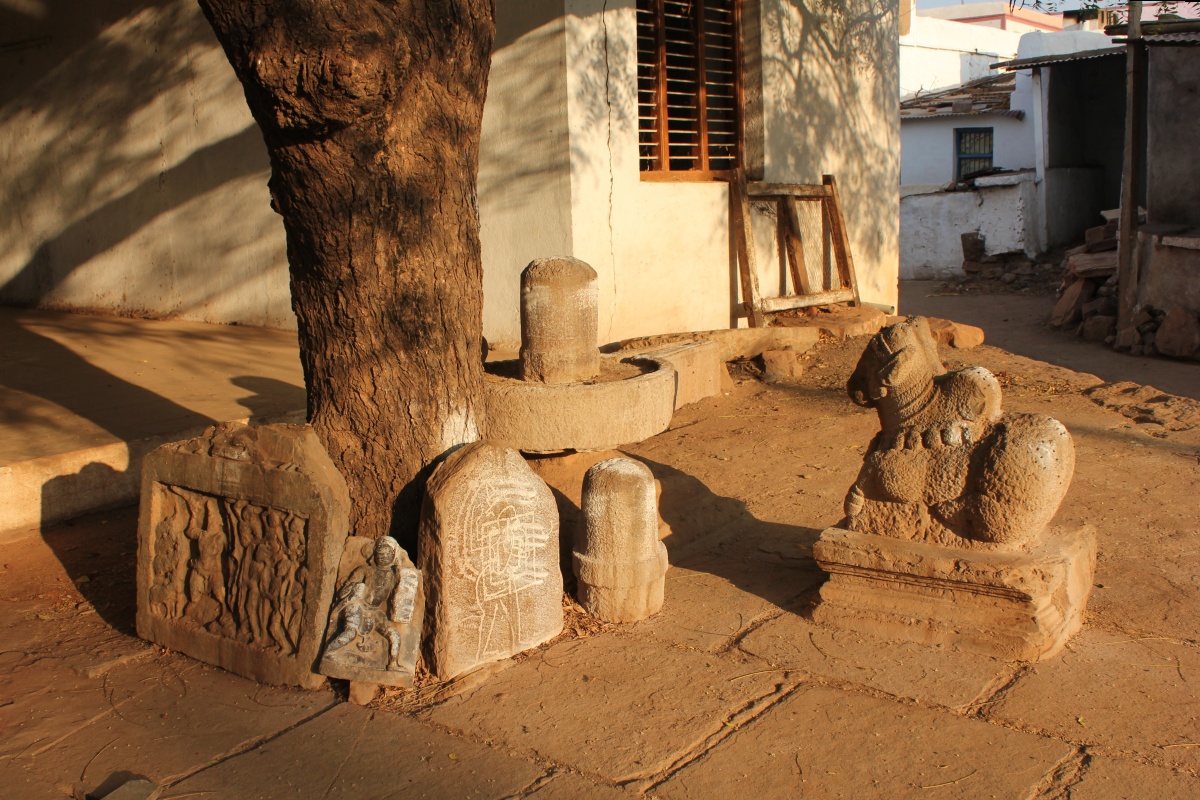
Katgeri folks were curious about strangers in their village, that too with cameras. We explained out interest in forts and ancient temples. Few suggested we see Ramlingeshwar temple and couple of hero-stones near the entrance. A small collection of ancient sculptures lying about neglected.

A young man showed us the way to Ramlingeshwar temple situated next to the western wall of the fort. The temple is ancient but every column and beam is covered in paint. This elderly man is the temple priest. He was going about his routine of sweeping the temple floor when we came here. His little grandson was helping him clean the temple.

Now we are looking at the south-western corner bastion. Builders had made use of the lake for security. This trench was a moat. If you look closely at the mound rising from the lake bed, you can see embedded blocks of stones- that was to strengthen the base and also prevent soil erosion during rains.

Katgeri has no dearth for temples. This little collection of ancient sculptures is places in front of another temple, I can't remember the name but its a Vishnavite temple. Just below the window, on the ground is a slab with Kannada inscription on it. It was covered with a hick layer of dust.

The person in white mandangi & panchee (extreme right) took the initiative of having the slab washed. The person with the green towel brought a pot of water and a broom and did the cleaning. We suggested the slab be placed vertically, in reading position. A part of the slab is missing, folks told that it might have been buried below the building. Anyway, we thanked this group for taking a small step to preserve their heritage.

Our shopkeeper friend showed us two more badly damaged inscriptions, lying in a corner next to the Gram Panchayath office :-(

As we spoke I mentioned about a relative with roots in Katgeri. Our friend was happy to hear that and introduced me to my relative's cousins. They invited us home but we had to decline because of time constraint, we still had four forts ahead of us. However, we all had tea and spoke for several minutes. They suggested us to see the collection of hero-stones and inscriptions at the high-school. We thanked them and left.

We went towards the high-school but changed our plans. We'll need time to climb four hills... we cannot afford to spend more time.

Our next destination: Guledgudda.

.........
Older Post ►
eXTReMe Tracker
 

Copyright 2011 Journeys to temple is proudly powered by blogger.com