Tampilkan postingan dengan label Caves. Tampilkan semua postingan

Talewadi - caves and a cascade

April 7, 2012

The drive from Degaon to Talewadi was a rough one. We had to get off at a uphill stretch and guide our cabby Balu. Indica's wheels spun before gripping the rocky-dirt patches. Balu proved to be talented driver. Soon we were driving a flat stretch of dirt road. We saw a couple of thatched roof huts but no humans in sight. Balu caught a movement in one of the huts. We stopped to check if this was Talewadi. Slowly, very cautiously two women, one elderly and one middle aged, emerged from huts. I said namaskar and asked for directions to Talewadi ...the elderly pointed down the road- a little further you'll see two more houses. Barely 250m away, after a bend a road was Talewadi.

These two milestones, a mile away from each other, are from the British era. Distance shown is in miles. These are real milestones. Places mentioned are Belgaum, Shirol, Khanapur and Talewadi.

Right next to the milestone (Talewadi 0) was a house and another one on a small hillock across the road. We saw a man emerge out of the house on the hillock. He was surprised to see us and even more surprised to see an Indica in his village. I introduced myself and the purpose of our visit- Krishnapur caves and Bheemaghad fort.  But since it was a bit too late to reach Krishnapur and Bheema, we'll plan that some other day. Can you show us Talewadi's cave? Yes. Our friend Sateri Dabale called out to his brother Ganapati Dabale and asked him to take us to the cave. Wow! What a host.

We took the Indica for another kilometer and parked at a dead end. From there we entered the jungle. Ganapati led the way, a narrow shaded path, it was silent except for birds and insects going about their chores noisily. Suddenly the shaded path ended and we were out in the open. The path winded through rocks and descended into a wide valley. The cave was neatly hidden behind a  clump of trees. The picture below is a screen shot from a video I made.

A short video of our walk through the jungle to the cave.

The cave's mouth is completely hidden by trees. A narrow path from the side led us into the cave. We approached it cautiously, Ganapati would ask us to walk in a single file as close as possible to the rocky wall to our right, in case we encountered an animal it'l have enough place to pass by. Memories of my visit to Tenginkalbetta came to my mind, our guide had told us animals tend to attack when encountered face to face. They rarely bother when seen to the sides. Slow steps, holding our breaths, we took the first step into the cave. It had a scary look, the innards dark and uninviting.

Ganapati checks if any beast was hiding behind these rocks. No, nothing. Than he told us about a snake he had seen years ago. We spoke in hushed tones.

Feeling confident, we relaxed a bit. The portion behind the group looks ideal for animals to lie down for sleep. No wonder Ganapati checked it.

We decide to explore deeper into the cave. The silence got thicker with every step. We could barely speak with the tension. Ganapti asked if we had a torch. We fished out my LED torch and handed it over to Manju since my hands were full with cameras.

Ganapati pointed out at a narrow opening to an inner chamber. Ganapati located an paw print in the moist floor, our untrained eyes could not pick it. Manju shone the torch at that point. We heard a low growl, a low but a nasty sounding growl for about 5 or 6 seconds. Balu asked Manju to switch off the torch. Now it was confirmed, we were guests and disturbing our beasty host.  We were tense but none of us panicked.

We decided to move towards the mouth for our own safety.

Close to where Balu is, to his left we found several prints of birds' feet.

Ganapati said we can see the rocks of Krishnapur caves from a point on these hills, let's go there. The path went up the roof of the cave. Ganapti, Manju and Balu are standing in the footpath used by animals to descend into the cave.

View of the valley floor and a smaller cave opposite the bigger cave.

After few minutes walk, we were at the highest point of Talewadi. The three small mounds above Balu's and Manju's heads are the rocks of Krishnapur. We are 800m and Krishnapur is 200m above the sea level. We need to descend 600m to reach Krishnapur!

Hope the day comes soon.

A natural stone arch. Miniature version of Sidlaphadi cave.

Ganapti was leading us to another cave. We were walking a crescent shaped valley floor. My guess- during rainy season a stream would be flowing here.

We dare not enter this cave, looks like a perfect home for bears and serpents. We rested here for a while. Earlier, while in the bigger cave I had told lighting a beedi scares away animals. Balu lit a beedi, we cautioned him, a carpet of dry leaves covered the ground we stood on. the cave is at the beginning is a slope. The caves terrace is a part of the valley floor we descended from.

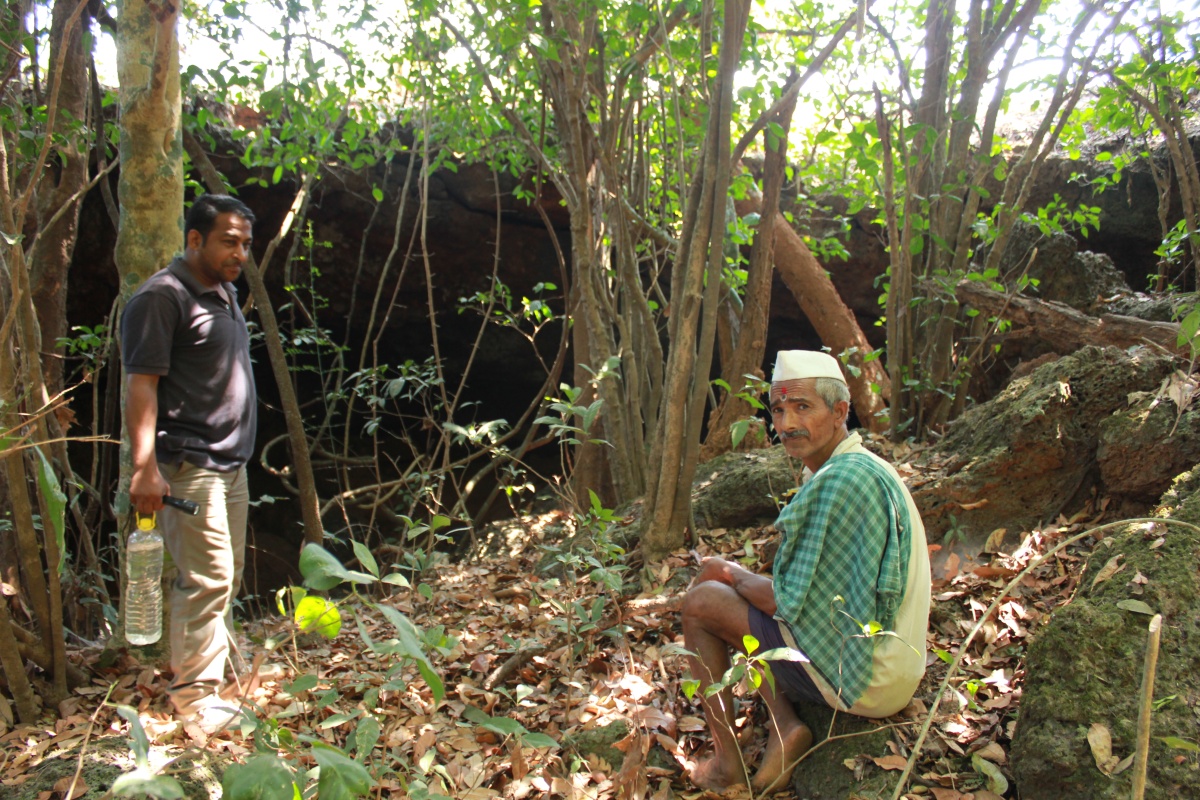
This tree is supposed to be a favorite play spot for tigers. Young tigers would be often found here. Ganapati claimed to have seen tigers running few paces and leaping on to the tree. They would sharpen their claws on the trunk and would lie on the branches. I believed his words. The tree has a kind of look which looks inviting to big cats.

Ganapati is a very patient man. I should spend few days in Talewadi, live peacefully away from the all the madness . We stopped at the cave we had seen from the bigger cave's terrace. I was glad Manju and Balu were enjoying the trip :)

On the way back to the hamlet, we stopped by to see another smaller cave.

We saw something we can never see in cites. A very different type of flower- white, blue and red.

The blue ones seem to the younger ones. The blue top falls off exposing the red inside.

We had crossed over this gully to explore two smaller caves. We spent few minutes examining the types of rocks. These  are ligneous rocks. We could see charcoal grey pebbles and stones, very heavy for their sizes. I picked a few for my collection at home.

We were hungry but something kept us moving. We headed towards the hamlet. Thanks to Rajshekhar Jahaj for suggestion to visit Talewadi.

This story will continue in the next post.

.........

sights from Sidlaphadi

Ant nest on the way


Silver Cockscomb, near Sidlaphadi


A dry plant hanging on to its rocky base.


Close up of the plant. You see the tiny flowers? Wonder if its really dry.


Growing out from rocks.


This rock face is almost vertical. Plants are truly the most versatile creatures.


Brown igneous rock.


Looks like remnants of an ant-hill?


It's a unique rock formation. I've seen such formations only in Sidlaphadi. I saw few such formations, some were much higher then this one. This particular one looks like a fortification in hills.


Few more similar formations.


An embedded pebble. Looks like lava solidified around this egg-shaped pebble.


Our shadows on the cave wall.


To see Sidlaphadi caves, read previous post.

.........

Sidlaphadi Caves

Aug 14, 2010. My first attempt to reach Sidlaphadi was aborted in two minutes. I decided the path was too rough to be walked on with sandals, for a four kilometer trek through rough terrain we need shoes. More over it was late to start the trek and I had no idea how to reach it. Few locals hanging around did not show any signs of helping us.

First week December 2011 I had my plan ready. I had checked the route in Google Maps and had a print out. I decided to stay overnight at Badami so that I can start the trek early. Dr.Umesh had introduced his school time friend Ranganath, a resident of Badami. If possible he would join me for the trek to Sidlaphadi. I would be staying at Ranganath's place.

Dec 16, 2011. I left Pattadakal by 6-30 and arrived at Badami by 7-45. Finding Ranganath's place was easy. I freshened up and as we chatted his colleague & friend Dhariappa Dharegonnanavar arrived. We went to KSTDC for dinner, food was good. I would have preferred a khanavali, we would have had better food at lesser cost. Back home it was decided that Dhariappa would accompany me for the trek. Though I was tired and not a single mosquito buzzing into my ears, I did not sleep well.

Dec 17, 2011. Woke up early. After cold bath I was fresh and felt energetic. As soon as Dhariappa was ready we took off. On Badami-Guledgudda road, just after hotel Badami Court is Konamma temple, I parked my car under a tamarind tree within the temple compound. Just across the road is the path to Sidlaphadi. It was 6-30. By the way I was in hawai-chappals :) somehow they seem to work well for me.

The uphill path was rough, scattered with rocks of various sizes. After a minute or so we were an even surface though a rough one. The stones were packed with cement, this looked like a foundation for a proper road ...so this is road project was abandoned for some reason. Tire marks and displaced stones told us that loaded tractors plied this path often. We spoke of agriculture, IT and tourism.

Soon we were looking up at a cell phone tower- that's an important landmark. Dhariappa is facing we should be taking.


Silhouette of a rock overhang. A wikimapia user had marked this as Sidlaphadi. This spot is just 1.25km from the main road.


Happy with the progress we trekked on. After the sharp left and sharp right turns near the tower, the path was more or less straight and level. We could see evidence of quarrying on these hills. Not long back what were beautiful rock formations are now broken up and look like sour wounds. The path we trekked on had a layer of fine red dust- that means regular vehicular traffic.


Around 7-15 I felt we were close to our destination. The path turned right and shrubs straight ahead ...it looked as though there no path ahead. The map confirmed there's no right turn here, so we went straight ahead and then a left turn and there it is.


I was ecstatic to be so close to this cave which was home to humans tens of thousands of years ago. We had to climb down into a shallow, narrow valley. If not for bird songs and leaves rustling the place would be totally silent. I was trying to imagine this place ages ago.


Google Map screen-shot


A - Sidlaphadi
B - small cave
C - cave with a window
D - cave 10 feet above ground level

At the cave entrance. The cave resembles a single arch bridge. The roof has three holes. Scientific research says these holes are cased by erosion. Local legend says they were caused by a lightning hence the name Sidla-phadi.


Length could be 50 feet and depth could be 30 feet. Height of the roof at its maximum could be 15 feet.


We spend few minutes in the cave and go out to the other side. It's a small open field with small trees and thorny bushes. People from surrounding villages come here to gather firewood. That's the reason the cave and its surroundings are free of bushes.


We discover this little cave, marked B in the screen-shot. Dhariappa called it a single room cave. This little cave has a small inner chamber which could be used to store food. Another extension to the left can be also be seen.


The level field ends here and a slope rolls down into a wide valley. Close to this point is another cave.


Cave with a window, marked C in the screen-shot. This cave reminds me of Phantom's Skull Cave ...one eyed skull cave. Its quite spacious inside. Close to this cave I found an interesting plant- entire plant has dried with flowers on it.


We go up to explore the cave top. We avoided stepping close to the edges. I feel long back the cave had much more interior space. Part of the roof might have collapsed. For instance, if you see the curved edge on the left, it might have been a straight line.


Holes in the roof.


A closer look. Notice the dry plant? It's stems are standing even when its dry. Proud little plant.


We discover another cave, marked D in the screen-shot.


This cave is a good 10 feet above ground level.


Other end of the valley. After a good downpour water would flow down in streams here.


Shadow on the left is Dhariappa's.


An inscription on the southern wall. I scanned the walls with a hope to see some paintings. No, nothing. Dhariappa pointed out to red colored shapes but they turned out to be stains of mud-water. An ASI book on Pattadakal refers to Sidlaphadi- Neolithic pottery, chert (a semi-precious stone) and microliths were found here. However there's no reference to pro-historic paintings of any sort.


From this angle I could cover half the cave. Try to imagine cavemen living here. Perhaps I should come here with a group of people & cavemen costumes and enact the scene.


Cave D as seen from ground level. To reach that cave we had to negotiate a steep rock face. I'm not going to try anything this time. The valley floor was sandy at places- that's proof for flowing water.


This unique rock formation reminds me of a portico.


Dhariappa found this unique stone and I kept it as a souvenir :)


 I wanted to be here some more time but Dhariappa had to be in the college by 10. Anyway, I had plans to visit again. Dhariappa ans I shook hand for successfully locating Sidlaphadi.

We walked back the way we came. We saw many such rock formations resembling an inverted icecream bowl. This one had a little cave it in, perhaps a fox hole.


Our breakfast was a pack of six Britannia oat cookies shared equally and little water. I'm not sure if it was oats that kept us charged. Our trek back was equally effortless.


Since we were familiar with the trial we took few short cuts. My feet had a thick coat of red soil. Luckily at the temple we could wash our feet and get into the car fairly clean. We went straight to Dhariappa's college on Badami-Banashankari road. It was 10 O' clock when I stopped near the diploma building.

Another place in Badmai on my wish list was Ranganatha temple. I wanted to finish it off before heading home.


Sidlaphadi Coordinates: 15°56'37"N 75°42'4"E

.........
Older Post ►
eXTReMe Tracker
 

Copyright 2011 Journeys to temple is proudly powered by blogger.com