June 30, 2012
Few people have heard of Banashankari temple of Amargol and even fewer visit the temple even though it is just 12 km from Dharwad and 16km from Hubli.
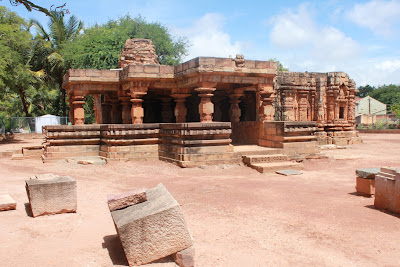 Amargol's Banashankari temple was built during 11th or 12th century AD by Kalyana Chalukyan kings. Made of sandstone, this temple is a Dwikutachala with its Garbhagriha's facing East and South. The temple has two entrances right opposite both grabhagrihas. In the east-facing Garbhagriha resides Banashankaridevi and in the south-facing garbhagriha is a Shivalinga.
 The temple is under ASI care. It has been restored, signs of repair works are quite evident.
 The external walls are damaged badly. Difficult to tell if damages have occurred naturally or human inflicted. Compared to other temples of the same era the damage is much more pronounced.
 As I went around checking the temple exterior I found this this eye-catching model rekha nagara shikhara. Somehow this piece of work is well preserved.
 The temple interior is proportional to the size of the temple. Outer columns are sandstone and the four columns forming the Kalyana Mantapa are of harder stone.
 Looking at the south-facing garbhagrih through the Kalyana Mantapa.
 The door-frame is heavily decorated with fine sculptures of floral art and mystical creatures. Gajalakshmi sits on the top.
 Namah Banashanramma.

 One column is relatively simple while one is quite complex and the remaining two are in between.
 Top half of the most richly decorated column.
 Notice the ridges created at the uppermost part of the columns? In the next level is a turned section with equally spaced four Kirthimuhka. All four Kirthimuha are same- enclosing a lotus.
 Notice the variations in this level of the pillar. This pillar below has equally spaced triangles.
 Below the turned section is a square section featuring Kirthimukha. Three of the four columns have 3 Kirthimukha on each of the faces...
 ...while one column features single Kirthimukha with multiple strands of beads flowing out from it. The design in between the strands is just too good. Mohan, a maternal uncle who was accompanying me told that he's seen this design in some wood-work. I too felt I'd seen it some where.
 The next level is a mix of circular and octagonal sections. The lowest level is a square section.
Bases of the pillars feature images of various gods on each of the faces- Bramha, Vishnu, Nataraja, Ganapati, Bhairava, Bhairavi, Shiva, Varaha, Ugranarasimha, Chandra and few others. The temple has a 3' x 2' black stone slab with Halegannada inscription on it. According to the inscription in 1120 AD a king named Jakkarasa got this temple built for Keshava and Bhairava. The inscription refers to Amargol as Ambaragol.
 The first God is saw Bramha. The picture below is of Varaha, Vishnu's avatar.
 This is one of the Adishaktis crushing a demon under her feet. Do take a closer look at this image by clicking on it.
 Mama found the images very interesting, he helped identify Bhairava. I think Mama was looking at Bramha while I was shooting.. not sure who this is but the character has a four arms with a Damaruga in one arm.

 A closer look. Who are these characters?
 An hour had gone by so quickly. I'm trying to imagine how this temple might have looked during its better days. Magnificent.
We went back to my car parked close to Hanuman temple. Saturday is Hanuman's day. Jai Bhajarang Bali.
 As you see the murthy is about five feet tall, its south-facing. This Hanuman does not have a bell tied to the tail. This may not be one of the Vyasraya's creation.
Visit to Amargol went well. Our next destinations for the day were ISKCON and Nuggikeri. We spent about 10 minutes at the Krishna temple and the drove down to Nuggikeri hanuman temple. Nuggikeri Hanuman is smeared with orange paint and decorated with bunches of Tulasi leaves. Could not make out the murthy's lakshanas. I checked with one of the temple archakas, he did not seem to have the right information. Anyway, I'll come back some other day.
Amargol Banashankari temple coordinates: 15°23'56"N 75°5'14"E
.........
Few people have heard of Banashankari temple of Amargol and even fewer visit the temple even though it is just 12 km from Dharwad and 16km from Hubli.


The four columns forming the Kalyana Mantapa are unique even though they seem similar at the first glance.


Bases of the pillars feature images of various gods on each of the faces- Bramha, Vishnu, Nataraja, Ganapati, Bhairava, Bhairavi, Shiva, Varaha, Ugranarasimha, Chandra and few others. The temple has a 3' x 2' black stone slab with Halegannada inscription on it. According to the inscription in 1120 AD a king named Jakkarasa got this temple built for Keshava and Bhairava. The inscription refers to Amargol as Ambaragol.


Again, no idea who this is. Notice the skeleton like character with folded hands and a dog with its fore legs raised up.


We went back to my car parked close to Hanuman temple. Saturday is Hanuman's day. Jai Bhajarang Bali.

Visit to Amargol went well. Our next destinations for the day were ISKCON and Nuggikeri. We spent about 10 minutes at the Krishna temple and the drove down to Nuggikeri hanuman temple. Nuggikeri Hanuman is smeared with orange paint and decorated with bunches of Tulasi leaves. Could not make out the murthy's lakshanas. I checked with one of the temple archakas, he did not seem to have the right information. Anyway, I'll come back some other day.
Amargol Banashankari temple coordinates: 15°23'56"N 75°5'14"E
.........
Detail:
Banashankarigudi, Amargol


