Tampilkan postingan dengan label bagalkot. Tampilkan semua postingan

Prehistoric rock-paintings of Badami

This hunt for Badami's rock-paintings had been going on for couple of years. Thanks to my friends Ranganath Juttannavar and Dhariappa.Dharegonnavar's help, a group of paintings has been located in Hiregudda barely 500m from Badami-Banashankari road. The word Hiregudda can be split into Hirae and Gudda meaning big and hill. The spot is on the sandstone hills right opposite Ranganath's house.

Sept 15, 2012
After a hectic day exploring Kutkankeri, Amingad and Aihole, we arrive at Badami and camped for the night at Ranganth's house. We had dinner and discussed plans for the morrow; one of Dhariappa's students- Pundalik -would be our guide to the spot and we would go there early, while Sun is still low. Ranganath's neighbor Mr.Satarkar an ex-ASI employee would be joining us- it would be great to have an elderly person for company. He mentioned his ignorance of the paintings existence even it was close to his house.

Sept 16, 2012
By 7 O' clock we grouped, had fresh tea at a chaha-angadi. Path to the painting passed through a residential locality.. as we walked folks gave us surprised looks. Pundalik lead us up the hill. The terrain got rough, it was littered with peek-jaali thorns. We were concerned about Satarkar's safety.
We had to reach the base of the rock, on the right corner.
At the base of the rock, ground was steep and dry with loose mud and small stones. Climbing here was a bit of a challenge; we had to be sure of the foot-hold with every step. The painting is on a flat surface  about 15 feet high, marked with a circle in this picture.
That's a prehistoric drawing board. The location is quit different from the ones seen earlier, most were in rock-shelters but this is a open rock face. Wonder why this spot? Did the painters use ladders or scaffolding to reach the board?
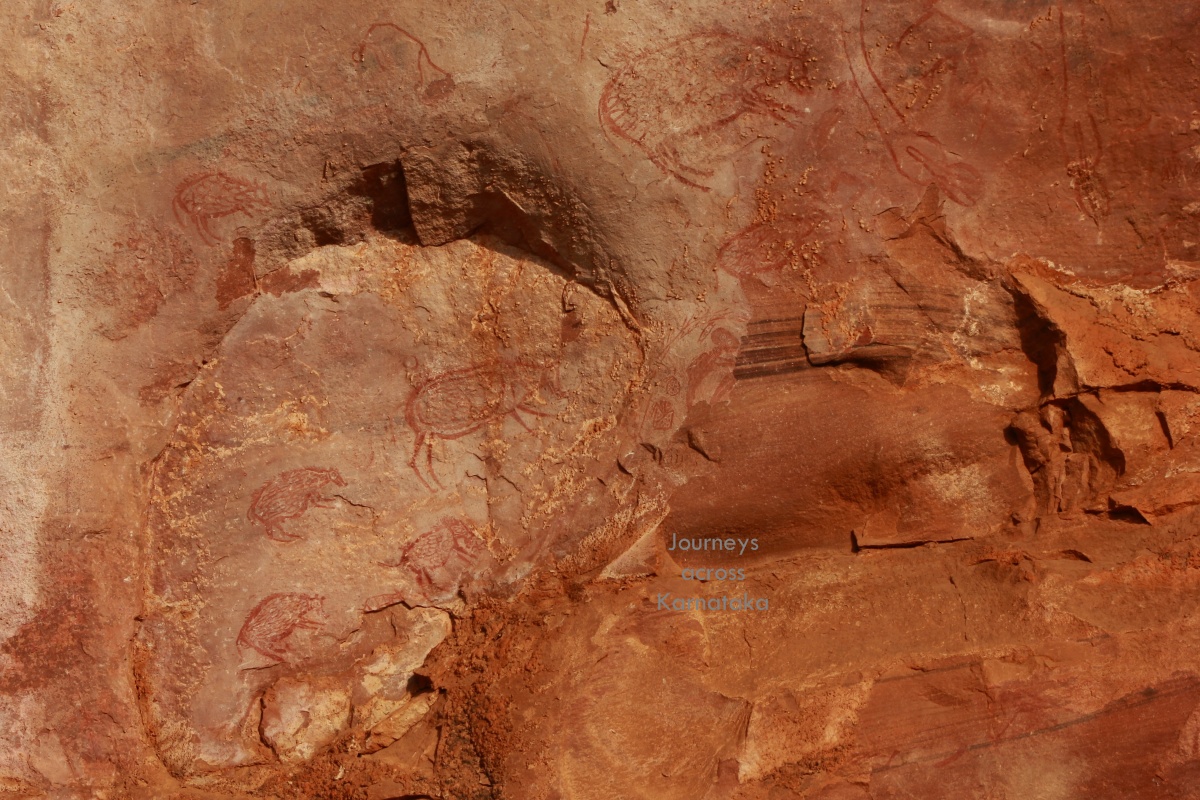
Our drawing board could be 9 feet wide by 5 feet high and faces the East. The board contains 30 to 40 individual figures painted in ocher, the only color seen here, color shade is more or less uniform. Facing east direction the board receives direct sunlight for 2 to 3 hours daily. In spite of being exposure to sunlight, the paintings have survived several thousand years. Also the painting is exposed to rain water dribbling down the rock face. The white patches seen here is a product of chemical reaction between stone and water. The other form of damage could be due to insect nests or insects laying eggs.
We'll take a closer look at the drawings. In my opinion these drawings of Hiregudda are rather unique, creatures depicted are unusual, not like the drawings of men, women or animals as seen in Onake Kindi or Kutkankeri. Hiregudda's drawings of human-like creatures and animals create a feeling you are looking at some form of extra-terrestrial life forms. Animals depicted here are some-what like pigs, boars, bulls, rabbits and mongooses. Another interesting point is the alignment of the some drawings; they are inclined, as though animals are standing on a slope.
In this frame we can see seven four-legged animals which seem like wild boars or wild pigs, but they are neither. Also at the top of the picture is a human-like figure, shoulder and heads drooping, arms dangling... seems like a dead tired person walking. Close to the center of the photo is a humanoi with a over-sized head, it seems like an astronaut.
Zooming in further, of the four creatures the smaller seem like pigs and the larger seems like a cow.
The cow-like creature. Notice the head, its very different from a cow's head. Hair on the shoulder and back are clearly visible, so is the tail. Coming to the body, did the artist try to show the creatures innards or is it a skin pattern?
Panning to the right, we see three humanoid figures; two figures closer to each other seems like a couple- a male and a female. The other humanoid is wielding stick like objects, one in each hand. Between the stick-wielder and the couple are two objects which seem like a jug and a tray. The tray could bread or a slab of chocolate or anything else. Amazing isn't it?
The couple. Though sex organs are not depicted these figures do seem like a male-female couple. The male is taller and better built than the female. The patterns on the body and limbs are skin patterns or are they attired in some type of garment? Notice two conical protrusions from the female's chest- are those breasts? Also in the picture is a headless humanoid, an incomplete picture?
Close to the female's right foot are two animals with short legs- rabbit or mongoose?
A thought here; I feel the paint used here could be blood. It's a fact that prehistoric artists used a mixture of ground minerals, crushed herbs and pig's blood to prepare paint.

Between the male's legs is another humanoid creature; the head is large with prominent eyes; body and arms have faded. Close to the male's right foot is a two legged creature.. can't say what it's like, the part of the drawing has faded.
Though these humanoids look frightful, they don't seem violent.
Stick wielding humanoid: head is covered with thick hair; small eyes; bent and tapering neck, long slender body, slender arms, well-built legs and tiny feet. A closer look at the head reveals hair tied into a plait. Is this a female? Skin has a checkered pattern and it seem like the feet are covered by some sort of shoes. The stick-like objects- doesn't seem like weapons.
Food objects: Wonder what these things are.
Panning to right, the board's surface gets rough. Also a white column covers the entire height of the board; this might be the effect of water. Sticking out of the white column is a humanoid at an inclination. The skin has zig-zag pattern. On the left is a four-legged animal. What could be the reason for inclined drawings?
I have rotated the picture for easier viewing. The four-legged creature seems like a bull; the head is small with big ears and has an extended snout, like a small trunk; tail is thick; body has a pattern similar to the cow-like creature seen earlier. The slight protrusion under the belly could be the sex organ.
The drooping humanoid: this is the only figure resembling an earthlings closely. Is it bowing down with respect or tiredness or sickness?
This creature looks like a combination of a pig, a deer and a cow. Please feel free to share your opinion. This animal has a pointed snout, scaly skin and thick hair along the spine.
The astronaut. This humanoid seems like its donning a space suit. Notice the vertical lines starting on the helmet and running down on the neck. It seems like wearing a backpack. The humanoid is holding something.. unfortunately part of the picture is missing. Oh, I just realized there's a base layer. Now it seems like the artists had painted a white base before painting the ocher drawing.
Besides the astronaut, there are three objects- wonder what they are. The rectangular object seems like a basket. The round object looks like a coconut or some sort of fruit. Everything's so different even though they have some resemblance to things on Earth.

Another humanoid: this seems like a female.. going by the figure and slender arms. This part of the drawing board is chaotic. Hard to understand.
In this frame are more humanoids resembling earthlings closely. Wonder what the long vertical object on the left is?
Are these figures actually earthlings and other humanoids are life from a different planet?
Few more humanoids in this frame.
In this frame two paintings have been encircled. I can' make out what's in the oval. Coming to the circle, its a very strange looking creature- a combination of tortoise and a bull; position & shape of the head seems like it's tortoise's. Body and tails looks like bull's. Are these creatures imaginative or did they exist here on Earth or do they exist some where outside our world?
That's the team.
Pundalik, Dariappa, Malatesh, Satarkar, Raju
These hills still have wildlife in them and local people hunt them for food or profit. Satarkar told a story of a local lad who died on this hill few days back. The boy had laid a bird trap on a ledge. While checking the trap he had fallen down several feet. Unfortunately he was alone when that happened. The boy's relatives alarmed on his missing launched a search and found his mutilated body after a week. The boy must have died in the fall; the body was attacked by a hyena or some other animal. Kannada word for hyena is Kattekiraba. One has to be careful in these hills, advisable to be in groups and always exercise care no matter how good a rock climber you are.

We must have spent an hour looking at the drawings. And spent some more time studying them at home. There are many questions: Who made these paintings? When were they made? Are the animals and humanoids imaginary or real? Wish I could get some answers. There are articles which mention extra-terrestrial beings in rock-paintings.

.........

Amingad fort

September 15, 2012

After exploring Kutkankeri hills, we stopped for lunch. Malatesh was exhausted, Suryadeva's effect. He slept off while Raju and I had lunch. When we were done, I woke Malatesh and forced and him to have little curd-rice... he agreed it felt better. Next on the itinerary were Guldegudda, Amingad and Aihole. I wan't sure about Guledgudda having a fort but I wanted to confirm.

Guledgudda is a small town at the base of a hill range. We could not see any ruins from the road. We inquired with local folks- no, there's no fort on the hill. However at one end of the hill range there was a bastion like structure which happened to be a temple. It would have good if I had climbed the hill to confirm but time and energy was in question. Well, if there was a fort, some on would have told it.. let's move on to Amingad.

Amingad is also a small town at the base of a hill range. The highway connecting Bagalkot to Kudala Sangama passes through Amingad. We could see ruins of the fort from the outskirts, now the question is where's the easiest path to climb the hill.

Google Map screen shot of Amingad town, hill & fort.
We took a narrow street running parallel to the hill, stopped by for a minute at Basaveswara temple. The temple shikhara is decorated with lot of sculptures. People were very curious to see two people shooting their temple. We asked for directions to the path leading to the fort; the path starts at the end of this hill, near the highway.
An ancient gateway in the same lane.
Finally we locate the path, passing through another narrow steep lane with small huts and houses. After a foot bridge across a trench, we were treading a steep dirt path flanked by Jaaligida jungle. At one point the dirt path gave way to a stairway. The steps were made of rough cut sandstone slabs.. we were struggling.. to make things easy we spoke jokingly about shifting to lower gears :)
These hills are a good source of stones for construction. Finally we reached the bastion. There was a small temple next to the bastion. We did not bother going in.
This level of the hill was windy and on the bastion wind was literally pushing us. We avoided going near the edges. This is what remains of a rampart wall, its completely collapsed.
Ruins of two bastions.
At the summit is a bigger structure, perhaps that was the fort's command point. What seems like a stairway from here is actually a wall.
This fort is in complete ruins. We decided to have a visual tour rather than climb up to the top. Descending was also tricky.. again we shifted to high gear and used special brakes to control speed :)

Bye Amingad. We took the road to Aihole, a 8 km drive.


Amingad fort Coordinates: 16°3'36"N 75°57'4"E

.........

Elephant Tomb at Galgali

First week May 2012
My Dodappa's invitation to join him and cousin Naveen at Mudhol was unexpected. It would be an opportunity to meet my Dodappa's brother-in-law Ramesh. Uncle asked me to confirm right away. My mind in a turmoil because of work related issues. I accepted Dodappa's invite, it would do me good to spend time with family. I confirmed. The plan was to reach Mudhol May 6th morning.

May 6, 2012
I left Dharwad by 6-15. Dharwad-Saundatti was like a cross country drive ...road construction work had commenced few weeks ago. Saundatti-Munvalli-Lokapur-Mudhol was a breeze. It was 8-20 when I drove into Ramesh uncle's farm. I was seeing Ramesh uncle after many years. Uncle had not changed much in those years, slim and fit like before. I was glad to see Ramesh uncle's mother too.

At 10-30 Kanbur lawyer joined us and we all went to Jamkhandi to see a cousin. We left Jamkhandi after lunch and headed towards Halgali, our destination was Kanbur's dairy farm. On the way Kanbur lawyer told us about an anti-British uprising in Halgali by Valmiki people (hunter tribesmen). The uprising was instigated by two brave warriors Jada and Bala. The uprising which started with slaying of 3 British officer ended with the execution of 16 Valmiki tribesmen including Jada and Bala. On the way back we stopped to see relatives at at Halgali. I was introduced to a school headmaster who narrated the Halgali incident. A relative even presented a book about history of Halgali.The headmaster told us about a lake in the jungle and other spots. He also mentioned a elephant tomb at Galgali. Later Kanbur lawyer took us to an ancient temple, Veerabhadresvaragudi. We left Halgali back to Mudhol, visited Kanbur lawyer's home and later he dropped us back to the farm. We planned to visit Galgali next morning.

May 7, 2012
Kanbur lawyer had called his acquaintance at Galgali- Mr.Nyamgoudar. We went straight to Nyamgoudar's home, got introduced, had a cup of tea and we were set to go to the elephant tomb. Nyamgoudar's nephew Anand was appointed our guide. Two minute walk through the main street of Galgali we reached the monument. I was expecting to see a four-pillared structure... nothing of that sort. It was simple raised platform but large enough to match an elephant's size. The monument is within the Gram Panchayat office compound. If not for this location, probably this monument would be unknown or worst it would have been vandalized and lost forever.

Anand volunteers to climb up. Then I too clamber up. The circular sculpture would be a lotus, I guess.
A pair of lions and a pair of elephant sculptures decorate the front part of the grave.
Not much information about this monument is available but people did mention that the elephant served in Aurangzeb's army during his Deccan campaign. According to an online document from The Gazetteers Department - Bhir; Aurangzeb  moved out of Maharatsra and established a camp at Galgali in 1690. In 1695 Aurangzeb had his camp moved to Brahmapuri (Solapur district, Maharastra). The document does mention use of elephants while camping at Galgali. Going by the these facts, this grave must have been built some time between 1690 and 1700.

I do not remember anyone saying that Aurangzeb himself rode this elephant. I wonder what the elephant was called as ...surely it would have had a name.

Floral art on two other sides. The fourth side was too close to a wall and plants had filled the gap.


That's Naveen, Vijay uncle and Nyamgoudar. A badami tree is the only shelter the elephant grave has.

Muslim rulers- Adil Shahis, Bahamanis, Mughals and many more -are known for their massive and expensive tombs. The kings would have their tombs built while they lived. But having a tomb built for an elephant is something different.

A short video-

On the way back home the elders went ahead. I stopped to buy a chilum from this cart shop selling tobacco, betelnuts and paan leaves. The Rs.10 chilum is made of clay.

That's Nyamgoudar's house. We exchange phone numbers, thank them and leave.

Galgali is a village on river Krishna's west bank. We went for a drive on the bridge across the mighty Krishna. The river was almost dry except for large ponds in the rocky bed. On the left was a barrage running the entire span of the riverbed. On the right I could see few boys diving into the ponds and swimming. Uncle would have loved to go for a swim ...bad luck- he was not carrying his swimming trunks.

Like any other village Galgali has two ancient temples; one of the temples is built on the rocky river bed, close to where boys were swimming. I wish I had checked out the temples but we were expected at Yedahalli Desai's vaade.


Elephant Grave's approximate coordinates: 16°25'6"N   75°26'17"E

.........

Haalsiddeshwara Fort, Siddanakolla

Dec 16, 2011

I missed these ruins during my previous first visit to Siddanakolla. Today, my second visit, I leave my car near the temple and get directions from a farm owner on the way to his fields. Laxman is his name. I had to walk through a field, then clamber across a stone wall and  pick my way through a quarry to reach the base of the hillock on which the fort was. The slope ahead is riddled with thorny shrubs of all sizes and somehow they seemed to grow where climbing was easiest. After scanning the slope I located this series of stones which some what resembled a flight of steps. I decided to go up this way.


Almost five minutes and couple of scratches on my arms I stand here looking at the ruins of Halsiddeshwar fort. The collapsed walls and the small pillar on the bastion reminds me of Gudur fort.


Other side of the bastion.


Siddanakolla temple about 600m away.


The fort is located on the northern edge of  this plateau. Condition of this bastion and rampart walls are slightly better.


Of four bastions, three have collapsed. I managed to climb up a heap of stones, even standing here to shoot this picture was an effort.


A maze of stone walls divide the space inside into small rooms. I'm surprised that these thin walls have been standing for God knows how many centuries. All walls in this fort are carefully arranged stones, no binding material to hold them together.


Engineering seems primitive but how old is this structure?

A cactus fills up one of the smaller rooms.


Even with rough cut stones the engineers have managed to create a straight faced wall.


Even the corners are perfect right angles.


This isn't a boundary wall around an open well. I looked inside trying to get some clue what this could be. Was this used to store grains?

Close by was this stone which was a part of a larger stone with a dead conical hole.


I wonder if this fort was abandoned before completion. Stones heaped on the either sides of the walls are waste to be moved later?


This is the fort's entrance.


Walls on either sides of the entrance seem to have collapsed.


This trial of stones makes me lean towards construction abandoned theory. This fort is a puzzle now.


On the way back, I stopped to check out this rock face in the quarry I has passed through earlier. Nature shows off its talent.


Beautiful isn't it?


I met Laxman again. In fact he was the one who told me the name of the fort. Other wise I had known it as fort near Mangalagud. Laxman said there's another fort on this hill ...six kilometers walk. I guessed he was referring to Chikanal fort. After exchanging byes I head towards Aihole, about 6 kilometers from here.

Halsiddeshwara fort co-ordinates: 15°58'31"N   75°52'38"E

.........
Older Post ►
eXTReMe Tracker
 

Copyright 2011 Journeys to temple is proudly powered by blogger.com