Varavina Malleshwara temple is about 4 kms east of Tekkalakote, the road passes through paddy fields. The moment we entered the place, it was like seeing a scaled down version of Hampi sans river. The scattered ruins, the architecture and the presence of a Frangipani tree was very much Vijayanagara style. It is said that the place was known as Devara Kallu ~ God's Stone when it was built. It was around 9AM, we were the only visitors. As you see the temple is situated on the hillock.
The hall on the left is the Kalyana Mantapa and the on the right is the main Gopura. Notice the pillar design, its quite different from the ones I've had seen earlier.
A pleasant surprise; a goshaala with half dozen calves. I love the look on their faces.
Gopura is brick and mortar.
The doorway is flanked by various sculptures. Just outside the doorway is a image could be a scene from Ramayana; Rama aiming an arrow at the golden deer while living in exile.
The presence of Damaru, Trisula and Nandi indicates lord Shiva here.
As we step in it felt as though we had entered from the back door. On our left was the care-taker's house. I wonder why those three tigers are painted... had Tipu donated money to this temple's maintenance.
On the left, after the tower is a long hall for pilgrims to camp. On the right is the temple.
Doorway to Sabha Mantapa. Well, I wish to meet the guys who painted..
Garbhagudi at the end of this aisle and to the right is Nandi (see inset).
A collection of hero-stones.
side entrance
This temple doesn't seem to have any kind of order, little confusing. Main Gopura is on the eastern wall but the Garbhagudi faces west and what seems like a south-facing side entrance must be the main entrance.
A mural resembling a human rib cage.. very strange piece of work indeed.
We could see half dozen small temples like these close to the base of the hills, on the plains. The larger structure on the right is a modern structure, a shed to park the temple chariot.
This shelter could serve as lodge for pilgrims or shops.
A short video by Malatesh.
I don't remember seeing any signage here, not much of information available. Having done with this holy place we head towards Udegola and Nittur to see Ashoka's rock edicts.
About 4 years ago during a trip to Aihole, at a snack shop while spaeking to local folks I learned about an ancient temple on the other side of river Malaprabha. One of the persons said it could be reached by crossing the cart bridge near Galaganatha and Ramlingeshwara temple complexes. I was curious about the temple but made no effort to locate it.
February 23, 2013
Itinerary of the day was to visit forts at Katgeri, Guledgudda, Shantagiri and Pyati and also an unknown fort near Pattadkal. After Katgeri and Guledgudda forts we took Guledgudda-Layagundi-Pattadkal road. About 9 kms to Pattadkal, at a village named Sabbatahunashi we stopped to ask if people knew about the unknown fort. Folks told us the only fort is at Layagundi; we had already passed through Layagundi and we had seen a bastion on a hillock. The person suggested us to check out an ancient temple and gave directions; a dirt track flanked by fields. The temple is called as Maleyavvana Gudi. He also said there's Halae Layagundi (old Layagundi) fort near by. However the walls have collapsed and people have looted the stones from the walls. We thank him and decided to check out the temple.
The track rougher as we went in deeper. 5 minutes later we found Maleyavvana Gudi, situated right next to a pond, at the base of a hillock.
The immediate surroundings was deserted, it was silent except for birds chirping. The temple is small but a beauty though it lacks any kind of care. The temple is raised on a high platform ~ adsishthana. A 5-step stairway leads to the mukha-mantapa which is connected directly to the garbhagudi.
In the garbhagudi is a heap of stones probably one of the collapsed walls. The deity, a oil & vermilion covered statue of Mahishamardhini is placed in the mukha-mantapa. The deity was decorated with pink periwinkles. The wall next to the statue is a recent addition, its not the original part of this temple.
Outside the temple, to its right were two more similar sculptures of Mahishamardhini. The sculptures were made of sandstone, hence they are so worn.
The platform ~ adsishthana is quite simple but not entirely plain. Faded floral designs surely would have looked great back then.
A close look at one of the murals.
So this is the temple Aihiole folks had mentioned. This must one of the experimental temples, built 1500 years ago by Badami Chalukyan kings.
This place would be amazing if rains were normal. The pond would be full and the temple would look fresh and bright.
We did look around for the fort but nothing in the vicinity. I gave up because this deviation plan should not upset the itinerary, we decided to head back the road and search for the unknown fort.
Here's a schematic showing the location of Maleyavvana Gudi. The dirt track we took is not shown here. If you wish to see the temple, go to Galaganatha temple complex and cross the bridge; the temple is a 10 minute trek from the river.
Our day started with an expedition to see prehistoric rock paintings on Badami hills with my friends Dariappa, Satarkar and Malatesh, and our guide was a local lad named Pundalik. The experience was extraordinary because the figures in those paintings were not the usual types seen at other prehistoric sites. They seemed to be pictures of extraterrestrial beings.. of course I've not seen any ETs but those pictures definitely were different from earthly beings. Then we had breakfast at Badami and went to Halae Mahakoota, the older version of Mahakuta. Then we were back at Badami to see the seldom visited spots of Badami. We went around Agastya Theerth, saw a small cave dwelling used by ascetics of ancient times, the ruins of present-day-sculptures, an ancient diving board and then dropped off Dariappa who had some work to catch up. Satarkar insisted us on visiting Maalagitti temple situated on the western side of Badami's north fort.
We climb up the steps towards the temple, the fort hill towering above us.
The temple is perched at the top of a large monolith.
It's a temple built on a raised Adishtana, has one Garbhagudi, a Sabha-Mantap and a Mukha-mantap. The interior is relatively plain while the exterior is moderately decorated with figures of gods and human beings. The sculptures are quite different from what can be seen at similar temples at Badami, Pattadakal and Aihole.
The front porch- Mukha-mantapa - features four heavy columns.
On the sides are grilled windows and sculptures of gods, elephants and human beings.
On each of the side walls, on the exterior are two large sculptures of standing Shiva and Vishnu on left and right respectively. Shiva's Trisula and Vishnu's Charkra & Shankha are prominently displayed along with there consorts Parvati and Laxmi.
The temple entrance is flanked by sword wielding Dwarapalas. On the left side, right next to the door is a Kannada inscription.
A metal rod stuck in a hole. Was it fixed to work as a stopper or did it get jammed by mistake?
Following are a series of sculptures on the exterior.
a chubby elephant head
King's sculpture?
Court jesters?
Men engaged in wrestling competition?
seems like a plump woman with a pot
more jesters?
a collage of frames depicting more people
musicians?
These images are different from others; they have a unique identity.
The temple offers a good view of the surroundings. The fort above and also part of the rock-cut temples on the other side of Agathya Theerth.
On the left are columns of rock formation; one of the columns is leaning on it's neighbor forming a shelter between them. In that shelter is a shrine ..now occupied by Muslims.
Badami is much more than what people know and what tourists see. Our thanks to Satarkar. Maalagitti temple is special to him because he started his career in ASI as a care-taker of this temple.
I was told about Kaaradgi by an aunt more than a year ago. Even after several rounds of research the exact location of the place remained unknown until the day I received Shivaleela's wedding invite. The wedding was planned at Kaaradgi Eranna temple and I was told how to reach; Dharwad-Shiggaon-Kaaradgi or Dharwad-Savanur-Kaaradgi.
December 9, 2012
Earlier during the day we had stopped at Adargunchi and Budarsinghi villages to see Doddappana Gudi and Hanuman temple. We reached Kaaradgi village by 10-30. On the village outskirts, right next to the road are these herostones.
Eranna temple is about a kilometer from Kaaradgi village. Its a very popular pilgrim center in Haveri and surrounding districts.The temple seen here is the new structure. We met Pushpa and few relatives at the temple. Wedding ceremonies had started early morning. I was wondering if this cement and steel structure had replaced the ancient temple. I was relieved when Pushpa told us about the underground temple.
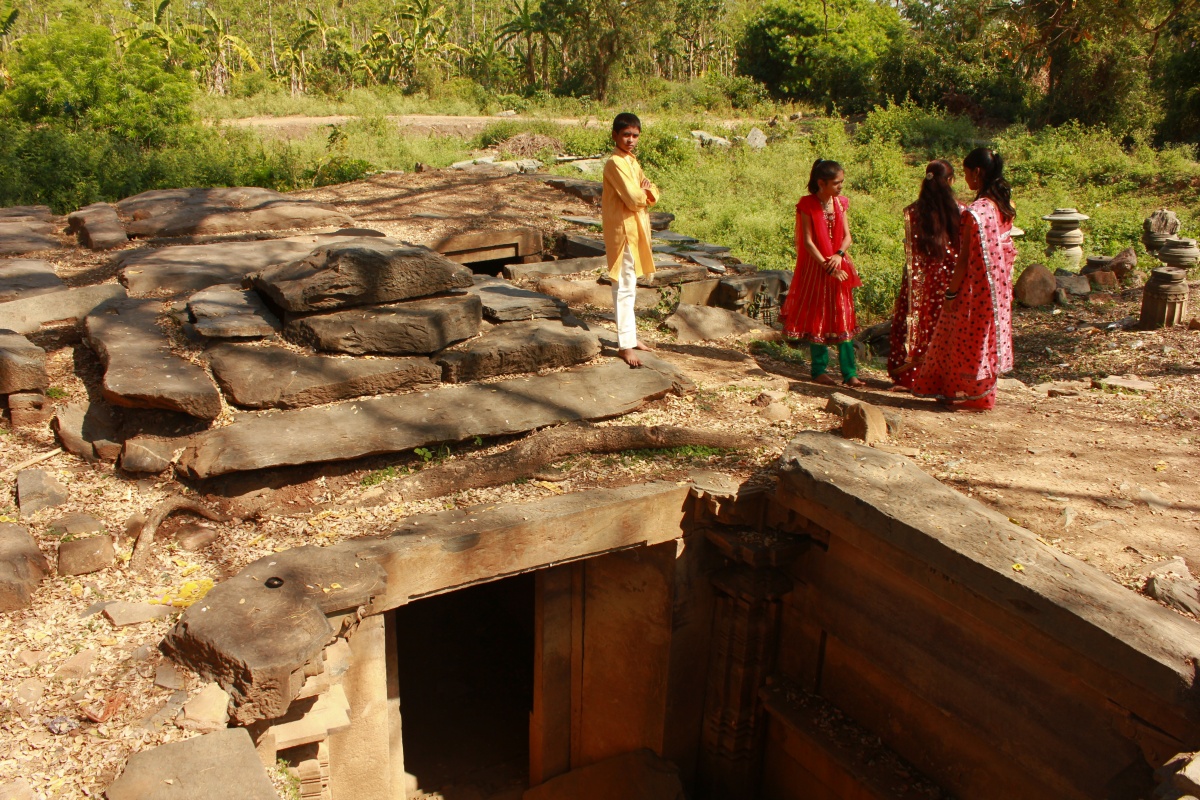
The underground temple is right next to the new temple. Its neglected and remains an unprotected monument. That's Shivu standing on the central dome.
I feel the temple might have been destroyed during an enemy raid. It's quite a big temple- these remains indicate a large hall, perhaps a Sabha Mantapa.
Assuming the temple had a Sabha Mantapa, we can say this is the entrance to the Antharala. Now, without the Sabha Mantapa standing this seems like the main entrance of the temple.
As I stepped into the Natya Mantapa, we could 3 Garbhagudi which means this temple is a Trikutachala Standing in the Natya Mantapa we are looking at the east-facing Garbhagudi. The inside was dusty but there was evidence of efforts to keep the place tidy. The pillars are basically squares with 16 sided fluted sections in the middle and top portion are circular sections. Architecture is similar to Bankapur Nagareshwara temple.
Shiva Linga in the east-facing Garbhagudi,
The temple is not really simple. Notice the Jaalandra flanking the door, as seen from inside the Garbhagudi.
This is the entrance to the south-facing Garbhagudi.
South-facing Garbhagudi as seen from the Antharala. Notice the elaborate sculptures decorating the door frame.
This is the north-facing Garbahgudi. As you see it's badly damages and the roof has collapsed completely.
I wish ASI takes care of this temple ruins and declare it a protected monument.
Wedding rituals were over and the newly wedded couple were getting ready for the reception. We had to wait for some time until the couple were onstage. While we wait we could check out the open air museum - that's what we chose to call but in reality it is a place for visitors to sit. We could see people sitting, having lunch and one or two lying down. Obviously these are parts of the temple we saw earlier.
In the center of the museum is this beautiful Basavanna. Unlike Basavanna seen at most places this one is not a calf, he seems like a grown up ox.
Remains of columns. The museum also has a herostone bearing a Kannada inscription (see inset).
Modern art work competes with ancient art work and looses out miserably. These cement & steel statue cant be more than 10 years old.
This video made by Malatesh shows the temple ruins better.
Done with the temple ruins and museum, we freshened up and head to the reception hall. After a few minutes of wait, we wished the couple and head to the lunch room. We were famished! Lunch was excellent, we relished the items. It was time to leave, said bye to Pushpa and her family.
We head towards Savanur with two things on mind; show Baobab trees to Malatesh and buy Savanur khara. A street vendor at Savanur suggested Shivalal angadi. We navigated the narrow streets of Svanur and found it easily. There it is Shivalal Savanur Khara and Sweet Mart.
We bought some Savanur khara and a sweet which the shopkeeper called Khambargatta. The sweet was in the form of slabs and extremely hard and brittle. The shopkeeper used a heavy steel object to break them. Done with shopping we head to Dodda Hunashe Matha to see the 3 baobab trees of Savanur, the only trees in Karnataka perhaps, India.